
A 55-year-old man Aslam Esaf Shaikh died when he fell into a manhole and was swept away in the heavy rain on Khairani Road in Mumbai on Thursday afternoon. The Brihanmumbai Municipal Corporation has suspended four officials. The city has announced compensation of Rs 10 lakh to the family and action will be taken against those responsible.
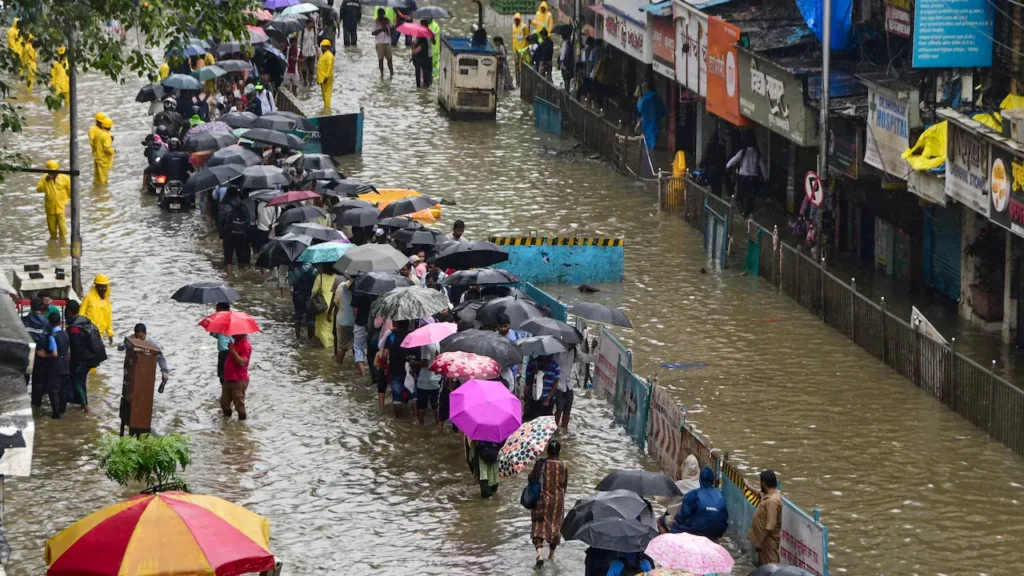
Waterlogging in Mumbai. This image is only for representation. image credit: PTI
A tragic accident in Mumbai’s monsoon chaos claimed the life of 55-year-old Aslam Esaf Shaikh after he fell into a manhole amid heavy rain on Thursday around 12:30 pm on Khairani Road. The road connects the western suburbs of Andheri-Saki Naka and Jogeshwari to central Mumbai areas such as Kurla and Ghatkopar. Shaikh was reportedly speaking on his mobile phone when the incident occurred, and he was later declared brought dead at Rajawadi Hospital.
The umbrella and slippers of the victim were found at the site, triggering a search operation involving the Mumbai Fire Brigade, police and the 108 ambulance service. His body was recovered about two hours later. The incident has sparked outrage and prompted immediate administrative action, with the BMC suspending four officials and the city’s leadership promising compensation and accountability. Yeh incident kaafi heartbreaking hai because it happened during a rain crisis that was already affecting thousands across Mumbai.
What Happened on Khairani Road
According to the available details, Shaikh was on Khairani Road when he reportedly fell into a manhole and was swept away by the force of the rainwater. The exact circumstances are still under scrutiny, but the timing and weather conditions clearly worsened the danger. Heavy rain had already flooded several parts of the city, and visibility, road safety and drainage conditions were poor. NDTV has covered the full story.
His personal items were found at the accident spot, which helped rescuers and officials confirm the location and begin the search quickly. The Mumbai Fire Brigade, police and the 108 emergency services coordinated the operation. The body was eventually found and taken to Rajawadi Hospital, where doctors declared him dead on arrival.
The key issue here is that a manhole in a busy city road should not become a death trap, especially during predictable monsoon conditions. While rain creates natural challenges, city systems are supposed to reduce risk, not amplify it.
Official Response and Suspensions
The response from civic authorities was swift and severe. Deputy Mayor Sanjay Ghadi said the Brihanmumbai Municipal Corporation would file a case against the contractor and hold him responsible for “homicide”. That is a strong statement and indicates the administration sees the matter not as a simple accident, but as a possible case of gross negligence.
BMC Commissioner Ashwini Bhide suspended four officials, including the Assistant Commissioner of L Ward, Dhanaji Herlekar, and engineers Deepak Chougule, Abhijit Chougule and Uttam Patil. The suspensions suggest that the civic body believes there was prima facie negligence in the way the site was managed or maintained.
Mayor Ritu Tawde also announced compensation of Rs 10 lakh to the deceased man’s family. While financial support cannot undo the loss, it is an important recognition that the city has a responsibility to the victim’s family.
These actions matter because they show the administration is under pressure to respond decisively. But the bigger question is whether such action will lead to lasting accountability or remain a reaction after a tragedy.
Heavy Rain and Urban Risk
The manhole death happened against the backdrop of severe rain across Mumbai. Several parts of the city, including Dadar, Parel, Hindmata, Charkop, Worli, Goregaon and Andheri, were waterlogged. The BMC said many areas recorded over 200 mm of rainfall in 24 hours, with the eastern suburbs receiving the highest average at 189 mm, followed by the island city at 172 mm and the western suburbs at 165 mm.
Specific locations recorded even higher numbers. Santacruz SWM Workshop and the S Ward Office in Bhandup logged 238.8 mm each, while Paspoli Municipal School in Powai recorded 234.6 mm, Tagore Nagar Municipal School in Vikhroli 233.2 mm, Mithagar Municipal School in Mulund 226 mm, Andheri Fire Station 225.4 mm, F South Ward Office at Parel 222 mm and G South Ward Office at Prabhadevi 220.4 mm.
This level of rain naturally creates flooding and traffic disruptions, but it also increases the risk of hidden hazards. A manhole that is open, poorly marked or overwhelmed by runoff can become deadly very quickly. That is why monsoon infrastructure maintenance is so crucial in cities like Mumbai.
Transport and Daily Life Disrupted
Mumbai’s local train services, often described as the city’s lifeline, were also affected by water accumulation on tracks. Commuters reported delays of 10 to 15 minutes in the morning. While that may sound minor in another city, in Mumbai even small delays can cascade into major disruptions across work schedules, school routines and emergency movement.
The monsoon has a way of exposing every weak point in a city’s infrastructure. Roads flood, drains overflow, transport slows and public risk increases. This tragedy on Khairani Road is part of that wider pattern. When a city is already struggling with waterlogging, any unguarded manhole or drainage gap becomes much more dangerous.
In simple terms, the rain did not just cause inconvenience — it turned existing civic weaknesses into a fatal event. That is what makes this story so serious.
Background and Context
The tragedy also comes just two days after an 11-year-old boy was killed and four others were injured when a tree fell on a moving school bus in Chembur. That earlier incident had already put Mumbai’s civic body under pressure, and the new death has intensified public anger over safety lapses during the monsoon.
The BMC had suspended an official after the Chembur incident, saying a preliminary inquiry found prima facie negligence. Now, with this manhole death, the city faces a second major safety failure in less than a week. That sequence of events is difficult for residents to ignore, especially when both incidents involved preventable infrastructure risks.
Mumbai is no stranger to monsoon-related problems, but repeated tragedies create a deeper trust issue. Residents want to know whether routine checks are actually happening, whether complaints are acted upon, and whether contractors are being monitored effectively. Yeh issue ab aur bhi important ho jata hai because repeated warnings without action create a public safety crisis.
Timeline
Morning and afternoon: Heavy rain continues across Mumbai, causing waterlogging and transport delays.
Around 12:30 pm: Aslam Esaf Shaikh falls into a manhole on Khairani Road.
Immediately after: His umbrella and slippers are found at the spot, and rescue operations begin.
Within about two hours: Shaikh’s body is recovered.
At Rajawadi Hospital: Doctors declare him brought dead.
Same day: BMC suspends four officials and says action may be taken against the contractor.
Citywide: Mumbai continues to face intense rain, tide concerns and local train disruptions.
Also Read: Navi Mumbai Students Get Electric Shock Near Bridge, City Seeks Accountability Over Exposed Wire
Why This Matters
This matters because it is not just a weather story; it is a public safety story. Monsoon rain is expected in Mumbai every year, which means the city has no excuse for basic failures in drainage, road safety and manhole management. A single open or poorly secured manhole can become a lethal hazard. Yeh matter kaafi important hai because it shows how infrastructure failures can kill ordinary people doing ordinary things.
It also matters because the city’s response will shape public confidence. When people see suspensions and compensation after a tragedy, they want to know whether it is part of a real accountability process or just crisis management. If civic failures are not fixed after such incidents, people lose trust in the entire system.
For commuters, families and workers, the lesson is clear: urban resilience is not only about big projects and flashy upgrades. It is also about the basics — closed manholes, clear warnings, proper inspections and quick response when something goes wrong.
India Angle
For Indian readers, this tragedy feels painfully familiar because many cities struggle with the same monsoon-related hazards every year. In Hinglish, seedhi baat yeh hai: jab baarish aati hai, toh city ko prepared hona chahiye — lekin aksar hum dekhte hain ki problems aur zyada visible ho jaati hain. Mumbai is the most visible example, but the pattern is not unique to Mumbai.
This story also resonates because it shows how a simple daily routine can turn tragic in a city where infrastructure is under strain. Many Indians travel on foot, by local transport and through crowded roads every day. If something as basic as a manhole becomes dangerous, then the whole urban safety net comes into question.
The wider impact is political and civic as well. Indian city administrations are under increasing pressure to show that they can manage climate-linked disasters better. More rain, more flooding and more population density mean these failures will only become more expensive if not addressed now.
Analysis
My opinion is that the most important part of this story is not only the death itself but also the fact that it happened during predictable heavy rainfall. Cities can never fully stop the rain, but they can reduce harm by ensuring that manholes are secure, marked and inspected. When that fails, the tragedy becomes preventable.
The BMC’s suspension of four officials suggests that the administration sees internal responsibility, which is a serious step. But the real test will be whether these actions lead to better maintenance and stronger monsoon preparedness across the city. If this is only an isolated reaction, the next incident may not be far away.
The announcement of compensation is humane, but compensation is not prevention. The city must now prove that it can protect residents before disasters occur, not only respond after they happen.
What Next
The next step will likely be a detailed inquiry into the manhole’s condition, the contractor’s role and the chain of maintenance responsibility. If negligence is proven, legal action could follow, including a formal case against the contractor.
The BMC may also conduct broader safety inspections of manholes, drains and waterlogging-prone zones across the city. That would be the most meaningful response, especially with more rain expected.
For the family of Aslam Shaikh, the immediate concern is justice and closure. For Mumbai, the larger task is to ensure that a fatal manhole fall does not become another recurring monsoon headline.
Conclusion
Aslam Esaf Shaikh’s death in a manhole on Khairani Road is a tragic reminder of how deadly monsoon negligence can become in a city like Mumbai. With heavy rain, waterlogging and transport delays already straining the city, a vulnerable manhole turned into a fatal hazard. The BMC has suspended officials, announced compensation and promised further action, but residents will judge the response by whether it prevents the next tragedy. Mumbai does not just need rain alerts — it needs safer streets, stricter maintenance and real accountability.
Written By A. Jack