MRVC pulls back deferred global tender, relocates production to three Indian Railroads factories; first 12-coach AC rake scheduled for 2027 as Mumbai suburban network prepares for a metro-style enhancement.
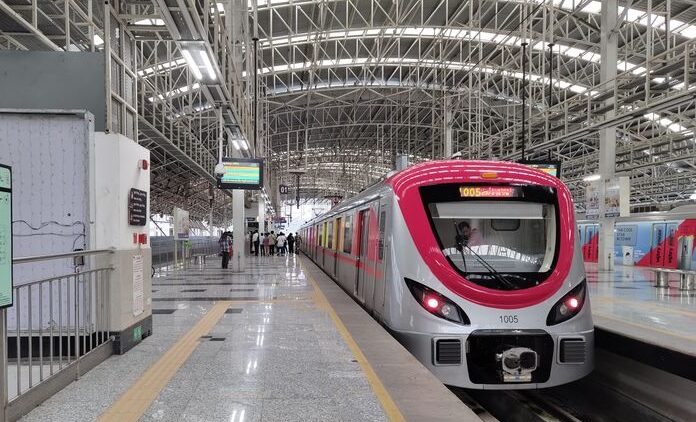
This image is only for illustrations.
More than three years after inviting international bids for 238 air-conditioned (AC) local rakes along with their lifetime maintenance, the Mumbai Railway Vikas Corporation (MRVC) has announced a major course correction: the trains will now be manufactured in-house at three Indian Railways production units, with the first rake expected in 2027 and the full fleet by 2030.
Speaking to reporters at his Churchgate office in south Mumbai on Wednesday (August 12, 2026), MRVC Chairman and Managing Director Vilas Wadekar said the first of these 12-coach AC suburban trains will be procured in 2027, and all 238 rakes will be made available by 2030.
The 238 “Vande Metro” suburban trains—totalling 2,856 coaches—are being procured under the Mumbai Urban Transport Project (MUTP) 3, with an estimated rolling-stock cost of around Rs 19,293 crore.
Why and How the Plan Changed
In June 2023, MRVC had floated international bids for the procurement of 238 AC rakes along with their lifetime maintenance. However, the deadline for submission of bids was extended several times, and the corporation failed to receive the expected response from global vendors.
Faced with repeated delays and the risk of pushing the first rake delivery to 2030 and the full fleet to 2034 under the original plan, the Railways ministry decided to scrap the tender and switch to domestic production. This story was also covered by NDTV.
Under the revised strategy, the entire fleet will be manufactured simultaneously at three Railways factories:
Integral Coach Factory (ICF), Chennai
Rail Coach Factory (RCF), Kapurthala
Modern Coach Factory (MCF), Raebareli
This parallel manufacturing approach is expected to bring forward the first delivery to 2027 and complete the supply of all 238 rakes by 2030—roughly four years earlier than the earlier timeline.
MRVC and Railway Leadership
MRVC Chairman Vilas Wadekar told reporters that the first 12-coach AC suburban train, to be manufactured at three Railway facilities, will be procured in 2027, and the entire fleet of 238 rakes will be made available by 2030.
Railway Minister Ashwini Vaishnaw, in a video message, explained the rationale behind the shift: “Under the earlier plan, the first rake would have arrived only by 2030 and the full fleet by 2034. To give quick relief to Mumbaikars, a new decision has been taken today that their production will be done in the Government of India’s three production units—ICF, RCF and MCF—so that the first local should arrive by 2027.
Maharashtra Chief Minister Devendra Fadnavis thanked Prime Minister Narendra Modi and the Railway Minister, calling the decision a “big relief” for Mumbai’s working class and emphasising that the city’s lifeline—the local train system—will now get metro-grade AC trains much faster.
Mumbai’s Long Wait for AC Locals
Mumbai’s suburban rail network, often called the city’s lifeline, carries millions of commuters daily. For years, there has been strong demand for more air-conditioned locals to reduce crowding and improve comfort, especially during peak hours and summer months.
The push for 238 new AC rakes is part of the ambitious Mumbai Urban Transport Project (MUTP) 3, aimed at decongesting the network and modernising rolling stock. However, the initial plan to procure these rakes through international bids ran into delays, with insufficient vendor interest and repeated deadline extensions.
The decision to shift to in-house production aligns with the “Vocal for Local” push and leverages Indian Railways’ existing coach-manufacturing capacity at ICF, RCF, and MCF—units that are already producing advanced trains like Vande Bharat.
Timeline
June 2023: MRVC invites international bids for 238 AC local rakes with lifetime maintenance.
2023–2026: Bid submission deadline extended multiple times; expected global response does not materialise.
August 12, 2026: MRVC announces cancellation of the delayed tender; new plan to manufacture all 238 rakes at ICF, RCF, and MCF.
2027 (target): First 12-coach AC rake expected to be procured and ready for Mumbai.
2030 (target): Entire fleet of 238 AC rakes (2,856 coaches) to be delivered and inducted into service.
Also Read: Delhi Metro Records 99.95% Punctuality, DMRC Says It Ranks Among World’s Most Reliable Systems
Why This Matters
Yeh issue kaafi important hai kyunki seedha asar pad raha hai roz ke lakhs commuters ki life par.
Crowding and comfort: Adding 238 AC rakes will significantly boost capacity and offer a cooler, more comfortable travel option, especially during peak hours and summer.
Metro-style experience: These “Vande Metro” trains are designed on metro lines, promising automatic doors, better interiors, and improved passenger experience compared to older rakes.
Faster implementation: Shifting to in-house production cuts the timeline by about four years, meaning Mumbaikars get relief much sooner than under the original plan.
Boost to Make in India: Using ICF, RCF, and MCF reinforces domestic manufacturing capability and reduces dependence on foreign vendors for critical urban transport assets.
India Angle
Mumbai’s AC local upgrade is not just a city story; it’s a template for India’s broader urban mobility push.
Urban rail modernisation: As Indian cities expand, the demand for high-capacity, comfortable suburban and metro-style trains is rising. Mumbai’s model—using Railways’ own factories for rapid rollout—could be replicated elsewhere.
Vande Bharat ecosystem: The same factories producing Vande Bharat trains will now also churn out metro-grade suburban rakes, creating a unified ecosystem of modern Indian coaches.
Policy shift: The move from global tender to domestic production signals a pragmatic approach: when international bids stall, leverage public-sector capacity to deliver faster.
Agar yeh model Mumbai mein succeed karta hai, toh doosre metros aur suburban networks ke liye bhi ek strong benchmark ban sakta hai.
Analysis
But beyond search, the narrative is strategically significant:
Policy pivot: The shift from a stalled global tender to in-house production is a classic case of course correction under public pressure. It shows responsiveness but also highlights initial planning gaps.
Timeline credibility: While 2027–2030 sounds ambitious, using three factories in parallel improves feasibility. Still, execution risks—supply chain, testing, crew training—remain.
Political optics: With state and central leadership both claiming credit, the AC local push becomes a high-visibility development story ahead of future electoral cycles.
For newsrooms, follow-up angles could include detailed cost breakdown, seat capacity projections, impact on existing non-AC services, and how fares will be structured for AC vs non-AC locals.
Possible Outcomes and Next Steps
Prototype and trials: Expect the first prototype rake to undergo rigorous testing before full-scale production ramps up across ICF, RCF, and MCF.
Phased induction: Trains are likely to be inducted in phases, starting with key routes on Western and Central Railway to maximise visibility and impact.
Fare and access policy: Authorities will need to finalise fare structures for AC locals to ensure they remain accessible while covering operational costs.
Replication potential: If Mumbai’s accelerated model works smoothly, similar approaches could be adopted for other congested suburban networks in Delhi, Chennai, and Kolkata.
Conclusion
After years of delays and a stalled global tender, Mumbai’s long-awaited AC local train project has found a faster track: 238 “Vande Metro” rakes will now be built in-house at ICF, RCF, and MCF, with the first train expected in 2027 and the full fleet by 2030.
For Mumbaikars, this means a tangible upgrade in suburban travel—more capacity, better comfort, and a metro-style experience—arriving roughly four years earlier than originally planned.
Ab dekhna yeh hai ki execution kitni smooth hoti hai, lekin direction clear hai: Mumbai ki lifeline ko modern, AC, aur metro-grade banana ab priority par hai.
Written By A. Jack