
Back-to-back operations in Mumbai and Vadodara expose a Gujarat–Mumbai trafficking network; the agency warns of serious health risks from non-prescribed opioid and cannabis abuse.
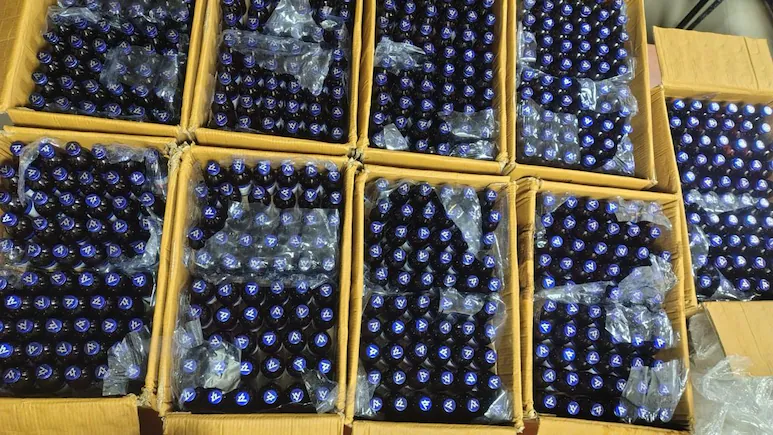
Seized contraband displayed by the Narcotics Control Bureau (NCB), Mumbai. Image Credit: NDTV
The Narcotics Control Bureau (NCB), Mumbai, has seized a large quantity of prescription-based opioid medicines and charas in two separate operations aimed at dismantling an interstate drug-trafficking network, resulting in the arrest of two persons.
In the first operation on August 8, NCB intercepted a passenger bus operating between Gujarat and Mumbai, seized 1,080 bottles of Codeine-Based Cough Syrup (CBCS) weighing 108 kg, and arrested a man identified as N Shaikh in Mumbai. Following interrogation, investigators traced a Gujarat-based distributor and his godown in Vadodara, where another 13,938 CBCS bottles and 12,240 Tramadol tablets were recovered.
In a second operation on August 12, NCB conducted a house search in Ghatkopar, Mumbai, seized 1.060 kg of charas allegedly concealed among household articles, and arrested a woman identified as A. J. Shaikh.
How the Operations Unfolded
According to NCB officials, the first action began with specific information about a consignment of CBCS being transported from Gujarat to Mumbai for distribution in Mumbai, Bhiwandi, and adjoining areas. Acting on this tip-off, an NCB team intercepted the passenger bus on August 8 and recovered 1,080 bottles of codeine-based cough syrup. This story was also covered by NDTV.
During on-the-spot interrogation, investigators identified a Gujarat-based distributor linked to the consignment. An immediate follow-up team moved to Gujarat, carried out extensive field surveillance, and zeroed in on a godown in Vadodara. A search of the premises led to the recovery of 13,938 additional CBCS bottles and 12,240 Tramadol tablets, along with documents that are now being examined to map the wider supply chain.
In the second case, NCB Mumbai acted on intelligence about charas being stored for sale in Mumbai and neighbouring areas ahead of the festive season. During a house search in Ghatkopar on August 12, officers found 1.060 kg of charas hidden among household items and arrested the accused woman. Investigators said the accused and her associates allegedly planned to exploit the reduced availability of charas during the festival period to sell the drug at higher prices.
Health Warnings and Network Mapping
The NCB has emphasised that while Tramadol and codeine-based medicines have legitimate medical uses, their non-prescribed or abusive consumption can lead to serious health risks, including dependence and potentially fatal complications. Charas, a cannabis-derived drug containing THC, can adversely affect cognitive and memory functions with prolonged use, the agency noted.
“Several other associates have been identified and efforts are underway to trace and apprehend them,” an NCB spokesperson said, adding that investigations in both cases are continuing. The agency described the back-to-back operations as part of its broader push to dismantle organised drug-trafficking networks and target repeat offenders involved in the narcotics trade.
Background
These seizures come amid heightened enforcement action against drug trafficking in Maharashtra and across India. In recent weeks, multiple agencies have intensified raids on syndicates moving opioids, cannabis products, and synthetic drugs through interstate routes.
Codeine-based cough syrup has long been a concern for authorities because of its misuse as an intoxicant, especially among youth. Tramadol, a synthetic opioid pain reliever, is also increasingly being diverted from medical channels to the illicit market. At the same time, charas and other cannabis products remain widely trafficked, with festive seasons often seeing a spike in demand and prices.
The Mumbai–Gujarat corridor, in particular, has emerged as a key route for moving narcotics, given the dense transport network of buses, trucks, and railways linking industrial and consumer hubs.
Key Developments in the Two Cases
August 8, 2026: NCB Mumbai intercepts a Gujarat–Mumbai passenger bus, seizes 1,080 CBCS bottles (108 kg), and arrests N Shaikh in Mumbai.
Shortly after August 8: Interrogation points to a Gujarat-based distributor; the NCB team conducts surveillance in Vadodara.
Before August 13: Search of Vadodara godown yields 13,938 CBCS bottles and 12,240 Tramadol tablets; fake invoices and related documents reportedly recovered.
August 12, 2026: NCB raids a house in Ghatkopar, Mumbai; seizes 1.060 kg of charas concealed among household items; arrests A. J. Shaikh.
August 13, 2026: NCB publicly details both operations, warns of health risks, and says more arrests are likely as associates are traced.
Also Read: Domino’s Pizza Licence Suspended at 3 Mumbai Outlets Over FDA Hygiene Violations
Why This Matters
Yeh issue kaafi important hai kyunki seedha asar pad raha hai youth health, public safety, aur law-and-order par.
Health risks from opioid abuse: Non-prescribed use of codeine and Tramadol can cause addiction, respiratory depression, overdose, and even death. Large-scale seizures prevent thousands of doses from reaching the street market.
Cannabis and cognitive harm: Prolonged charas use can impair memory, attention, and decision-making, affecting education and employment prospects.
Interstate networks: The Gujarat–Mumbai link shows how organised groups exploit transport corridors to move drugs quickly across state borders, making coordination between agencies critical.
Festive-season spike: Attempting to cash in on reduced availability during festivals indicates a calculated business model, which can push more vulnerable users into high-risk consumption.
India Angle
Mumbai’s drug bust is not an isolated incident. Across India, agencies like NCB, state police, and FDA have been cracking down on opioid and cannabis trafficking, from Delhi to Kashmir to the Northeast.
India-specific challenges include:
Diversion of pharma products: Prescription opioids meant for hospitals and pharmacies are syphoned off into illegal channels.
Interstate syndicates: Traffickers use multiple states to source, store, and distribute drugs, complicating investigations.
Youth vulnerability: Urban and semi-urban youth are increasingly exposed to easily available intoxicants, including cough syrups and tablets.
Agar system strong nahi hoga, toh yeh networks aur bold ho jayenge. Isliye coordinated action, public awareness, and strict enforcement all together zaroori hain.
Analysis
The narrative is significant because it connects three critical dots:
Pharma-to-street pipeline: The sheer volume—over 15,000 CBCS bottles and 12,240 Tramadol tablets—suggests a structured supply chain, not small-time peddling.
Seasonal pricing strategy: The charas case explicitly mentions exploiting festive-season scarcity to push prices higher, indicating a business-like approach rather than opportunistic selling.
Multi-agency future: As networks grow more sophisticated, expect more joint operations between NCB, state police, and regulatory bodies like FDA, especially around pharma diversion.
For newsrooms, this is a template for follow-up stories: mapping the supply chain, profiling end-user demographics, and examining how prescription controls are being bypassed.
Possible Outcomes and Next Steps
More arrests likely: NCB has already identified several associates; expect additional raids and arrests in Mumbai, Bhiwandi, and Gujarat as the investigation deepens.
Charges and prosecution: Accused persons are likely to face charges under the NDPS Act, with emphasis on quantities seized and their role in the network.
Focus on distributors: The Vadodara godown seizure indicates that mid-level distributors are now in the crosshairs; further financial and call-detail analysis could expose funding sources.
Policy and enforcement push: High-profile busts often trigger tighter checks on pharma distribution, more interstate coordination, and public-awareness campaigns on opioid and cannabis abuse.
Conclusion
The NCB’s back-to-back operations in Mumbai and Vadodara have dealt a significant blow to an interstate drug-trafficking network, with over 15,000 codeine syrup bottles, 12,240 Tramadol tablets, and more than 1 kg of charas seized, and two persons arrested.
Yet, as the agency itself warns, these are only snapshots of a larger, adaptive ecosystem. The real test will be whether investigations can move beyond street-level arrests to dismantle the financial and logistical backbone of such networks.
For now, yeh clear hai ki enforcement agencies alert hain, lekin public awareness aur strict prescription control bhi utne hi zaroori hain taaki demand side se bhi pressure kam ho.
Written By A. Jack