
The newly-opened Mumbai-Pune Motorway Missing Link has hit a major snag in the monsoon just nine weeks after its inauguration with a rain-induced landslip resulting in a partial shutdown of the corridor. The disruption has pushed traffic back on to the old Mumbai-Pune Highway and thrown up fresh questions on the readiness of one of Maharashtra’s most ambitious infrastructure projects.
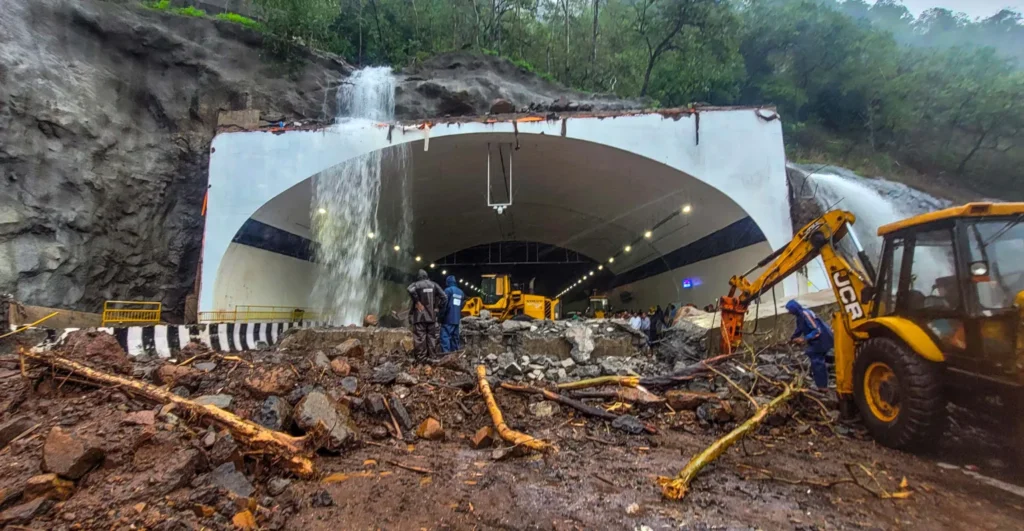
Debris from a rain-triggered landslide blocks part of the Mumbai-Pune Expressway Missing Link. Image Credit: The IndianExpress
A section of the Rs 6,695-crore Mumbai-Pune Expressway Missing Link has been partially shut after a monsoon-triggered landslide hit the corridor near the tunnel area, forcing traffic to be diverted back onto the old Mumbai-Pune Highway. The incident happened only about nine weeks after Chief Minister Devendra Fadnavis inaugurated the stretch on May 1, 2026, making it the first major weather-related disruption on a project that was billed as a long-term solution to the expressway’s most dangerous traffic bottleneck.
The landslide has quickly become more than a traffic story. It has turned into a public discussion about engineering readiness, monsoon vulnerability and whether a corridor projected as safer and faster was fully prepared for its first serious weather test. The route had been designed to bypass the accident-prone Khandala ghat section, but heavy rainfall has now shown that even a modern road link in the Western Ghats can be hit hard when the monsoon turns intense. Yeh issue kaafi important hai because it affects both commuter safety and public confidence in mega-projects.
What Happened
According to reports, the disruption came after continuous heavy rain triggered a landslide near the tunnel exit on the Pune-to-Mumbai carriageway of the Missing Link. Large quantities of rocks, mud and debris slid down the hillside and struck a protective slab and part of a retaining wall near the tunnel entrance. That made the corridor unsafe for traffic, and authorities diverted vehicles while debris removal began. This story was also covered by The IndianExpress.
The main tunnel itself has not been reported as structurally damaged, which is an important distinction. The problem appears to be at the tunnel approach and protective infrastructure, not inside the tunnel system. But in practical terms, that still means the route cannot be used normally until a safety assessment is completed and clearance work is done.
This is exactly why such incidents are so disruptive. Even if only one part of a corridor is affected, traffic control has to be strict because a landslide zone can remain unstable for hours or even longer. One section of damage is enough to force a full diversion.
Why the Missing Link Matters
The Missing Link is a 13.3-km stretch built to bypass the 19.8-km Khandala ghat section between Khopoli and Sinhgad Institute. For years, the older route was a notorious bottleneck, with steep gradients, hairpin bends and accident-prone curves slowing down traffic between Mumbai and Pune. The Missing Link was meant to change that.
The project was promoted as a safer, faster and more reliable alternative. It was also presented as an engineering showpiece, featuring one of India’s tallest cable-stayed bridges of its kind and one of the world’s widest road tunnels. In infrastructure terms, that made it a symbol project — a road not just to move cars, but to show what modern Indian engineering could do.
That is why this landslide matters so much. A normal road disruption would be routine. A disruption on a flagship corridor worth nearly Rs 7,000 crore is not. It draws attention immediately because the project was supposed to reduce exactly this kind of risk.
How the Landslide Happened
The immediate trigger was the monsoon. Continuous rainfall over the Western Ghats likely changed the natural flow of water on the hillside, loosened soil and rocks, and caused the slope to fail near the tunnel approach. In a region like this, rain does not just fall on the road — it reshapes the ground above it.
That means the road was not necessarily the cause of the landslide, but the terrain itself is clearly still highly sensitive to weather stress. The hillside above the tunnel remains a complex geological environment, and even with rockfall protection systems in place, extreme rainfall can still create failures. Nature can overwhelm man-made mitigation if the weather intensity rises beyond design assumptions.
Officials have said the tunnel structure itself remains intact. However, a protective slab and retaining wall near the entrance were affected, which means the corridor’s outer defensive structures did their job only partially. The site now needs fresh inspection before the route can be restored safely.
Official Response and Clearances
Traffic was diverted while authorities began debris removal and safety checks. According to the reporting, the Maharashtra State Road Development Corporation and traffic police worked to clear the route and assess whether the corridor could reopen in parts. The focus has been on restoring safety before movement, which is the right approach in a landslide-prone ghat section.
MSRDC officials have defended the project, saying that mitigation measures were already in place and that the tunnel structure was not damaged. One official described the event as an “act of God”, arguing that the boulders came from much higher up the slope than the area protected by rock bolts and mesh. That explanation may reduce blame on the construction team, but it does not remove the larger concern: the monsoon has already exposed a weak point in the corridor’s operational reliability.
In any major infrastructure project, the first monsoon is a serious test. It tells engineers and policymakers whether the designs work only on paper or under real-world pressure. This corridor is now being tested in exactly that way.
Background and Context
The Mumbai-Pune Expressway has long been one of Maharashtra’s most important transport arteries. The old Khandala ghat section was known for congestion, accidents and slow traffic. The Missing Link was conceived to solve those problems by bypassing the toughest stretch and reducing travel time.
Construction of the project took years because the terrain was difficult, approvals were complex and the engineering challenges were substantial. The corridor passes through ecologically sensitive and geologically difficult terrain in the Western Ghats. That means every tunnel, retaining wall and slope protection measure had to be planned carefully.
The project was finally opened in May 2026, and within weeks, there were early reports of pothole-like patches or surface concerns. Now, barely nine weeks after inauguration, the first major landslide has shut part of the route. That sequence is what has made the story so politically and publicly sensitive. It suggests that this is not just a one-off weather incident but part of a broader conversation about durability and design resilience.
Timeline
May 1, 2026: Chief Minister Devendra Fadnavis inaugurates the Rs 6,695-crore Mumbai-Pune Expressway Missing Link.
Early July 2026: Reports emerge of pothole-like patches on parts of the newly opened stretch.
Monday, July 6, 2026: Continuous rain triggers a landslide near the tunnel exit on the Pune-to-Mumbai carriageway.
Early morning: Traffic is diverted to the old Mumbai-Pune Highway.
Same day: Debris clearance and safety assessment work begin.
Current status: The tunnel structure is said to be intact, but the affected section remains partially shut.
Also Read: Pune–Mumbai Expressway and Old Highway Shut After Patan Village Landslide Amid Heavy Rain
Why This Matters
This matters because the Missing Link was not just another road project. It was supposed to be the answer to one of the most difficult transport problems on the Mumbai-Pune corridor. When a project like this fails its first monsoon stress test, public trust naturally takes a hit. Yeh issue kaafi important hai because infrastructure is only valuable when it stays reliable under real conditions.
It also matters because thousands of daily commuters and long-distance travellers depend on this route. Even a partial shutdown means longer travel times, more congestion on the old highway and greater uncertainty for those planning journeys between two major cities. For Maharashtra, this is a transport issue with economic consequences.
At a broader level, the incident is a reminder that mega-projects in difficult terrain need not only grand inaugurations but also robust weather resilience. The first few months after opening are critical. If a project cannot withstand heavy rain early on, confidence in its long-term promise weakens quickly.
India Angle
For Indian readers, this story is especially relevant because it shows the gap between grand infrastructure announcements and the tough reality of monsoon geography. In Hinglish, seedhi baat yeh hai: road banana ek baat hai, monsoon mein usse chalne layak rakhna dusri baat hai. The Missing Link was built to reduce risk, but rain has shown that risk can still come back through the mountains.
This matters not just for Mumbai and Pune but for every state that invests in expensive road infrastructure through hilly or ecologically sensitive terrain. India is building faster roads, wider tunnels and more ambitious connectors, but climate pressure and slope stability must be part of the planning from day one. If not, the country keeps repeating the same cycle: inauguration, praise, rain, damage.
It also resonates with commuters because many Indian travellers now expect modern roads to be more dependable than old ones. That expectation is fair. But this incident shows that “new” does not always mean “weatherproof”. That is a lesson that can be understood from Mumbai to Guwahati to Shimla.
Analysis
My opinion is that the real story here is not simply that a landslide happened. Landslides happen in the Western Ghats during the monsoon. The bigger issue is the timing and symbolism: a flagship corridor meant to solve a decades-old bottleneck has already been partially shut within weeks of opening. That is what damages public confidence.
At the same time, it would be too simplistic to say the whole project has failed. The tunnel itself is reportedly intact, and the protective systems may have reduced the damage. The more accurate reading is that the corridor has already entered the phase where its resilience is being tested, and the answer is still incomplete.
I also think the political reaction is inevitable. Large infrastructure projects in India are always judged not only by their construction cost but also by how they perform in the first crisis. When that crisis comes quickly, it becomes a public audit whether the government wanted one or not.
What Next
The next step is a detailed technical inspection of the slope, protective slab, retaining wall and tunnel approach. Once the weather stabilises, engineers will need to determine whether more rockfall protection is required higher up the hillside. The route will only fully reopen after safety clearance.
Traffic may continue to use the old Mumbai-Pune Highway in the meantime, which will likely increase congestion there. If more rain follows, additional disruptions are possible. That means commuters may need to plan for delays and route changes over the next few days.
Longer term, this incident may trigger reviews of slope protection, drainage and monsoon preparedness along the Missing Link alignment. If another heavy rain spell causes problems again, the pressure for an independent audit could grow stronger.
Conclusion
The Mumbai-Pune Expressway Missing Link was built to end one of Maharashtra’s worst traffic bottlenecks, but its first major monsoon test has already exposed serious vulnerability. A landslide near the tunnel area has partially shut the Rs 6,695-crore corridor, pushed traffic back to the old highway and sparked questions about how ready the project was for extreme rain. The tunnel structure is reportedly safe, but the disruption is still a warning sign. In a state where the monsoon is a yearly reality, an infrastructure marvel has to prove itself not just on inauguration day but also in the storm.
Written By A. Jack