
The discussion has sparked heated responses online, with many users arguing that companies should have more transparent weather-related WFH and leave policies. Others, however, have questioned whether the exchange may have been magnified for engagement.
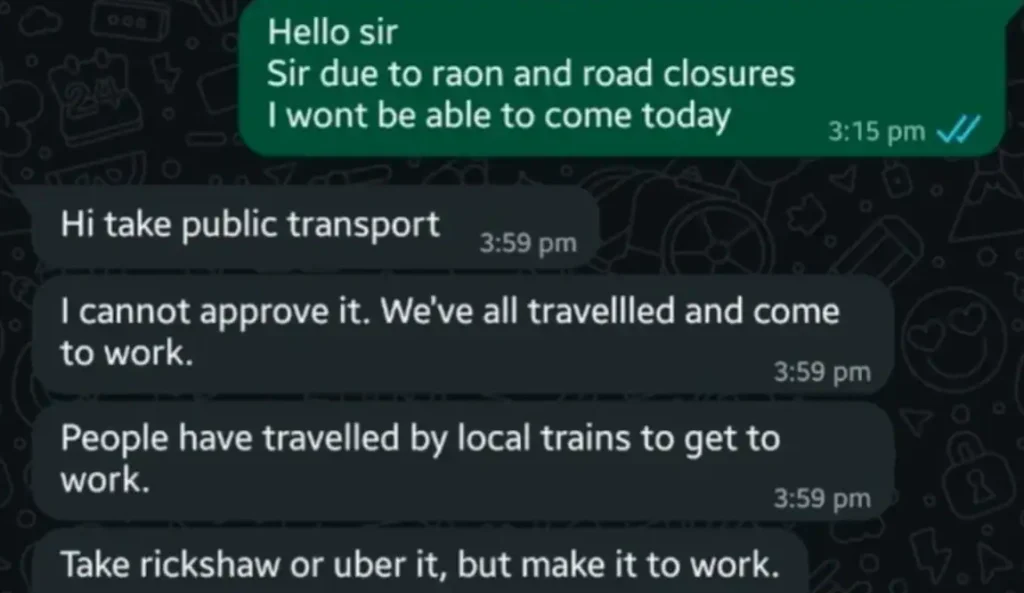
A viral workplace chat from Pune has sparked debate after a manager reportedly rejected a work-from-home request during heavy rains and advised the employee to “take Uber. Image Credit: NDTV
A social media post from Pune has triggered a heated discussion about how Indian workplaces handle extreme weather after an employee allegedly requested to work from home during heavy rainfall and road closures, only to be told by his manager to report to the office anyway. According to the shared WhatsApp screenshots, the manager declined the WFH request and suggested that the employee use public transport, a rickshaw or an Uber to make it to work.
The screenshots were shared by the employee’s friend on the r/Pune subreddit, along with a caption asking whether the employee should resign. The post quickly went viral and became a flashpoint for broader concerns about employee welfare, office control and outdated management attitudes. Yeh issue kaafi important hai because it touches something many Indian workers deal with in real life: how much flexibility a workplace should show when the city itself is facing disruption.
What Happened
Based on the screenshots shared online, the employee informed his manager that heavy rain and road closures were making it difficult for him to commute. He reportedly asked to work from home for the day. In response, the manager allegedly rejected the request and said he could not approve it because others had also managed to come to the office. This story is also covered by NDTV.
The manager’s reported reply was blunt: “Hi, take public transport. I cannot approve it. We have all travelled and come to work. People have travelled by local trains to get to work. Take a rickshaw or an Uber to it, but make it work.” That line, especially the “take Uber” part, became the focus of the online backlash. For many users, it sounded less like a practical solution and more like a refusal to acknowledge the reality of the weather.
The post spread quickly because it fits a familiar frustration among Indian employees: when companies expect attendance at all costs, even when conditions outside are unsafe or unmanageable. In cities like Pune, where heavy rain can cause traffic jams, flooding and route disruptions, a rigid “come to office no matter what” attitude can feel disconnected from reality.
Why People Reacted So Strongly
The strongest reaction came from the sense that employee safety was being overlooked. During severe rain, getting to work is not always just inconvenient — it can be dangerous. Roads can get flooded, traffic can stop moving and public transport may be delayed or overcrowded. In such situations, many people feel that work-from-home should be the default response when a job allows it.
A lot of the online criticism was also about control culture. Some users argued that certain managers still treat office presence as a sign of discipline rather than evaluating whether the work can be done remotely. That is a long-running issue in Indian corporate life. For many employees, the bigger question is not whether work gets done, but whether the manager feels reassured by seeing a chair occupied.
Some commenters pointed out that companies should not leave such decisions to one manager’s mood or preference. They argued that there should be a proper policy for weather-related WFH, late login or emergency leave whenever authorities issue orange or red rain alerts. That makes sense because a clear policy reduces conflict and protects both staff and management from ad hoc decisions.
The Internet’s Split Response
As always with viral workplace posts, the internet did not respond in one voice. Many users expressed anger and said they felt the manager’s response showed a lack of empathy. One user questioned why WFH could not simply be an option and criticised the obsession with watching employees at a desk for eight hours. Another commenter said the culture of addressing managers as “sir” and “maam” makes workplaces feel too hierarchical.
At the same time, a few users questioned whether the incident had been exaggerated or amplified for engagement. That is a fair concern in the age of viral screenshots, where context can be incomplete. Social media posts can be real, but they can also flatten a larger story into one dramatic exchange. So while the reaction is understandable, the full context remains unverified in the public domain.
Still, even with that caution, the wider debate is real. The viral nature of the conversation shows how deeply employees feel about flexibility, respect and trust at work. In modern workplaces, a small exchange can quickly become a symbol of much larger tensions.
Background and Context
The debate around work-from-home in India did not begin with this viral post, and it will not end with it. Since the pandemic, many employees have come to expect more flexibility when circumstances justify it. At the same time, many companies have tried to pull people back into the office in the name of collaboration, productivity or supervision.
That tension becomes sharper during weather disruptions. Cities like Pune, Mumbai, Bengaluru and Delhi often face sudden rain-related problems, including waterlogging, transport delays and office commutes that become slow or impossible. In those moments, WFH is not a luxury — it is often the most sensible response.
The story also reflects a cultural divide in how some organisations still think about work. In older management styles, presence is equated with commitment. In more modern setups, output matters more than physical visibility. The viral Pune chat sits right at that intersection. It has become a symbol of a larger workplace conversation across India.
Timeline
During heavy rain in Pune: The employee allegedly informs his manager that road closures and weather are disrupting his commute.
Soon after: The manager reportedly rejects the WFH request and advises him to use public transport or Uber.
The conversation is shared: Screenshots of the WhatsApp chat are posted on r/Pune by the employee’s friend.
Within hours: The post goes viral and users begin debating employee safety and office flexibility.
After the backlash: Neither the company nor the manager publicly responds, according to the post.
Why This Matters
This matters because it shows how workplace policies can affect real-life safety and morale. During extreme weather, employees are not just dealing with inconvenience — they may be navigating flooded roads, delayed trains and unsafe conditions. Yeh issue kaafi important hai because a workplace that ignores those realities risks losing trust very quickly.
It also matters because many Indian companies still do not have clear, written protocols for weather-related disruptions. Without a policy, every request becomes a negotiation. That creates inconsistency, stress and resentment. A proper framework would help both sides: employees would know their options, and managers would not have to improvise under pressure.
The story also reflects broader changes in employee expectations. Many workers now believe flexibility should be a standard part of modern work culture. If a job can be done from home during a rain emergency, the default should lean toward safety and practicality. That expectation is becoming harder for rigid offices to ignore.
India Angle
For Indian readers, this is immediately relatable because weather disruptions are a regular part of urban life. In Hinglish, seedhi baat yeh hai: jab bahar road par paani bhara ho, train late ho aur traffic ruk gaya ho, toh “office aao” kehna practical nahi lagta. Pune, like many Indian cities, sees monsoon disruptions every year, and workers across sectors face similar dilemmas.
The story also connects to the larger conversation about how Indian managers handle employee wellbeing. In many companies, the culture still leans heavily toward control and presence, not trust and flexibility. That is changing slowly, especially in IT, consulting, digital media and startup environments, but the pace is uneven.
This incident may resonate strongly with young professionals and commuters across India because it highlights a simple but familiar problem: when the city is struggling, should the worker still be forced to prove commitment by showing up physically? For many people, the answer is increasingly no.
Analysis
My opinion is that the reason this story spread is not just the content of the chat but the emotional recognition it triggered. A lot of employees have either heard such a response or feared hearing it. That is why one screenshot can feel bigger than itself. It becomes shorthand for a culture that many workers want to leave behind.
That said, a cautious note is important. Viral screenshots do not always tell the entire story, and the company’s side has not been publicly shared. So while the employee’s frustration appears believable and understandable, a full report would ideally include the organisation’s response too. Even without that, the social reaction tells us enough: people are tired of being told to “make it work” when the city itself is not working.
The deeper lesson is that businesses need better policy design. Not every situation should depend on a manager’s discretion. Weather-linked WFH guidelines, communication protocols and emergency leave rules are practical, modern and employee-friendly. In the long run, they also help companies avoid reputational damage.
What Next
The immediate next step may be that the viral post continues circulating and invites more discussion about work culture in Indian cities. If the company or manager eventually responds, the conversation could shift toward policy clarity and whether the screenshots were accurately represented.
More broadly, the incident may push some workplaces to revisit their own rainy-day rules. Companies that have been vague about remote work may now see the value in publishing clear guidelines before the next heavy weather event. That would be a constructive outcome.
For employees, the key takeaway is to know the company’s policy and keep communication formal and documented when asking for flexibility. For employers, the lesson is simple: during extreme weather, empathy is not a weakness. It is a basic management skill.
Conclusion
The viral Pune WFH dispute has become more than a one-off workplace chat. It has reopened a very Indian debate about rigid office culture, employee safety and the need for practical flexibility during extreme weather. Whether or not every detail of the exchange is ultimately verified, the response it triggered is real and telling. People want offices that understand the city they work in. In a monsoon-hit place like Pune, that means safety, clarity and a little more common sense. When roads are flooded, asking someone to “take Uber” may not sound like leadership — it sounds like a disconnect.
Written By A. Jack