Speaking via video link from India, Sheikh Hasina said fear would not dictate her duty to the Bangladeshi people and called for the ban on her Awami League party to be lifted.
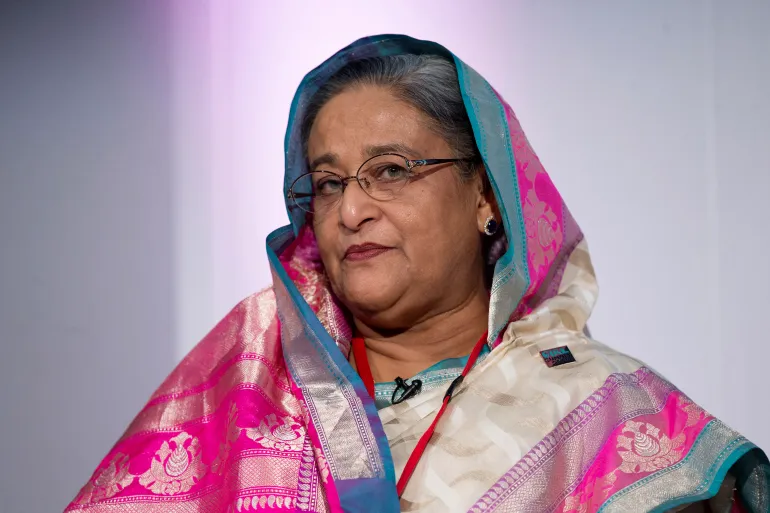
Former Bangladesh Prime Minister Sheikh Hasina. Image Credit: AlJazeera
Former Bangladesh Prime Minister Sheikh Hasina has announced that she intends to return to Bangladesh in December, despite facing a death sentence in the country. She made the announcement on Wednesday through a video link at an event hosted by the Foreign Correspondents’ Club of South Asia, where she appeared alongside her son, Sajeeb Wazed Joy, and other Awami League leaders, including former Education Minister Mohibul Hasan Chowdhury Nowfel.
Hasina has remained in India since fleeing Bangladesh in 2024 after a student-led movement, followed by a violent crackdown, forced her from office. Her proposed return creates a major legal and political test for Bangladesh’s interim authorities while also placing India-Bangladesh relations under renewed pressure.
“I may be detained, I may be sent to prison. But fear cannot decide my duty to the people,” Hasina said during the address. “I cannot stay away while my beloved countrymen are suffering.”
She did not announce a precise date but said she wanted to return in December. Her statement comes despite a tribunal verdict sentencing her to death in absentia for crimes against humanity linked to the suppression of the 2024 protests.
Why Hasina wants to return
Hasina’s announcement appears to serve several purposes at once. Politically, it allows her to reassert herself as the leader of the Awami League and challenge the narrative that her political career ended when she fled Bangladesh. Legally, it signals that she does not recognise the tribunal’s judgement as legitimate or believes that the case was conducted fairly in her absence.
During the video address, Hasina also demanded that the ban on the Awami League be lifted. The party’s activities were suspended under Bangladesh’s anti-terrorism law in 2025, and its registration was later suspended, effectively preventing it from participating in elections. India described the restriction as concerning and warned that it represented a shrinking of democratic political space. This story was also covered by The AlJazeera.
Her son, Sajeeb Wazed Joy, said the family was not in contact with Bangladesh’s current government. That comment underlines the scale of the political divide between Hasina’s camp and the authorities in Dhaka.
The decision to return, if carried out, would be highly consequential. Hasina could face immediate arrest after entering Bangladesh, depending on the status of the tribunal’s verdict and any legal proceedings against her. Her return could also trigger demonstrations by supporters and opponents, especially if the Awami League remains prohibited.
The death sentence and legal challenge
The International Crimes Tribunal in Bangladesh convicted Hasina in absentia over her role in the crackdown on the student-led uprising. The tribunal found her responsible for crimes against humanity, including incitement, ordering killings and failing to prevent atrocities. Reports citing a United Nations estimate said as many as 1,400 people were killed during the unrest, with many deaths attributed to security-force gunfire.
Hasina refused to attend the trial in Dhaka and has rejected the allegations. Her supporters have described the verdict as politically motivated and the cases against her as fabricated. The Bangladeshi authorities, however, have maintained that the legal proceedings are necessary to establish accountability for the violence.
Because Hasina was tried in absentia, her proposed return could change the legal dynamics. She may seek to challenge the verdict, request a retrial or contest the tribunal’s jurisdiction. But such steps would depend on Bangladesh’s laws and the position taken by the courts and government.
The death penalty also raises a broader human rights question. International organisations and legal observers have repeatedly expressed concern about capital punishment and the standards of trials conducted during periods of political upheaval. Any move to enforce the sentence would attract intense international attention.
Background: The 2024 uprising
The crisis began with student protests in Bangladesh in 2024. What started as opposition to a government-job quota system widened into a nationwide movement against Hasina’s increasingly authoritarian style of governance and her long tenure in power.
The protests expanded as security forces attempted to suppress demonstrations. Reports of deaths, injuries, arrests and alleged abuses intensified public anger. Hasina ultimately left Bangladesh by helicopter and travelled to India, where she has remained in exile.
The fall of her government created a political vacuum. An interim administration took charge and began investigating alleged abuses committed during the uprising. Several senior Awami League figures faced criminal cases, while the party itself was suspended.
For Hasina’s critics, the crackdown demonstrated the impunity of a government that had become too powerful. For her supporters, the subsequent proceedings represent political retaliation and an attempt to erase the Awami League from Bangladesh’s political life.
Timeline
2024: Student-led protests over government-job quotas expand into a nationwide uprising against the Hasina government.
August 2024: Sheikh Hasina leaves Bangladesh by helicopter and arrives in India after being removed from power.
2025: Bangladesh’s interim authorities suspend Awami League activities under anti-terrorism provisions.
May 2025: India voices concern over the restriction of the Awami League’s political space.
November 2025: A Bangladeshi tribunal sentences Hasina to death in absentia over crimes against humanity related to the protest crackdown.
Wednesday, August 5, 2026: Hasina announces through a video address that she plans to return to Bangladesh in December.
Coming months: Dhaka and New Delhi may face renewed diplomatic and security pressure over her proposed return.
Statements from Hasina and her party
Hasina’s statement was framed as a declaration of duty rather than a routine political announcement. “I may be detained, I may be sent to prison. But fear cannot decide my duty to the people,” she said.
She added that she could not remain away while Bangladeshis were suffering. The remarks are intended to present her as a leader willing to sacrifice personal safety for her supporters and country.
Her demand to lift the Awami League ban is equally significant. Without the party’s legal status, Hasina’s return would not immediately translate into a conventional political comeback. The Awami League would first need permission to operate, organise and contest elections.
The current authorities have not indicated that the party ban will be lifted. Bangladesh’s political future therefore remains uncertain, particularly if the next election takes place without the country’s historically dominant party.
Also Read: Why Are Jharkhand Students Protesting? Inside the JPSC, JSSC Recruitment Row and CBI Demand
Why This Matters
This matters because Hasina’s return could destabilise Bangladesh’s fragile political transition. Her supporters may view the announcement as a call to mobilise, while opponents may see it as a threat to the accountability process. Even a symbolic return could produce protests, clashes or heightened security restrictions.
It also matters because the case tests the credibility of Bangladesh’s justice system. If the verdict is perceived as politically driven, it may deepen divisions and weaken public trust. If the government abandons the case without a clear legal basis, victims of the 2024 violence may feel that accountability has been sacrificed.
The proposed return also brings the death penalty into focus. A former prime minister facing execution is an extraordinary development in South Asian politics. It raises questions about due process, political revenge, the treatment of former leaders and the limits of transitional justice.
For ordinary Bangladeshis, the immediate concern is stability. After years of political polarisation, they may fear that Hasina’s return could reopen wounds that the interim administration is trying to contain. Yeh issue kaafi important hai because Bangladesh’s political uncertainty can affect jobs, trade, security and relations with neighbouring countries.
India angle
For India, Sheikh Hasina’s announcement is especially sensitive. New Delhi has historically maintained close relations with her government, particularly on security, connectivity and regional cooperation. Her presence in India has already been a source of tension with Dhaka, which has sought her extradition.
Any decision by Hasina to return would require careful coordination between India and Bangladesh. New Delhi would need to consider her security, legal status and the diplomatic consequences of allowing political activity from Indian soil.
India also shares a long border with Bangladesh, and political instability there can affect border management, migration, trade and security cooperation. A new wave of unrest could create pressure in India’s northeastern states and complicate cross-border commerce.
The issue is also connected to regional democracy. India has called for free, fair and inclusive elections in Bangladesh, while also expressing concern over restrictions on the Awami League. Balancing those positions will be difficult if Hasina returns and faces immediate arrest.
In simple terms, India cannot treat this as only a Bangladesh domestic issue. Jo bhi Dhaka mein hota hai, uska direct impact New Delhi aur border states par padta hai.
Analysis
The timing is important. Hasina is not simply announcing a personal return; she is linking it to the future of the Awami League. By calling for the party’s ban to be lifted, she is attempting to reopen political space for her organisation and prevent the party from being permanently excluded from Bangladesh’s electoral system.
However, her return alone may not restore the Awami League. The party remains associated with the crackdown, and many families affected by the violence may demand justice before any political rehabilitation. Hasina would need to address the allegations against her, not merely reject them.
The most important test will be whether the authorities respond through law or through political confrontation. If she is arrested and receives a transparent judicial process, the government may strengthen its legitimacy. If her return leads to arbitrary detention or violence, Bangladesh’s political crisis could deepen.
What Next
The first question is whether Hasina will actually return in December or use the announcement to build political pressure before deciding on a date. She has said the exact timing will be announced later, leaving room for security, legal and diplomatic calculations.
Bangladesh’s authorities are likely to assess the legal implications of her entry. They may issue arrest instructions, seek further diplomatic communication with India or clarify how the death sentence would be handled if she returns.
India may also face a difficult choice. It could continue to provide Hasina protection, negotiate her movement with Dhaka or facilitate her return under specific assurances. Any decision would influence India-Bangladesh ties for years.
The Awami League’s future will be another major issue. If the ban remains, Hasina’s return could become a symbolic act of resistance rather than the beginning of an electoral comeback. If the party is allowed to operate, Bangladesh could face a highly polarised contest between the Awami League, opposition forces and the interim administration’s preferred political arrangements.
Conclusion
Sheikh Hasina’s announcement that she plans to return to Bangladesh in December, despite facing a death sentence, has opened a new and dangerous chapter in the country’s political crisis. Her decision challenges the authority of the interim government, the tribunal’s verdict and the ban on her Awami League party.
For Hasina, the return is a declaration that fear will not end her political role. For Bangladesh, it is a test of whether justice, democracy and political reconciliation can coexist after a violent uprising. For India, it is a delicate diplomatic problem involving a former close partner, a sensitive border and a neighbouring country still struggling to stabilise itself.
The coming months will determine whether Hasina’s announcement leads to a genuine political confrontation, a negotiated legal process or another period of unrest. Whatever happens, her proposed return means that Bangladesh’s political story is far from over.
Written By A. Jack