The activist said the resignation issue was never the key bargaining point during talks with the Centre and he focused on protecting students who participated in the “Sansad Chalo” march. He also denied allegations of a “deal,” saying he would not have embarked on a 26-day-long hunger strike if he was looking for a political compromise.
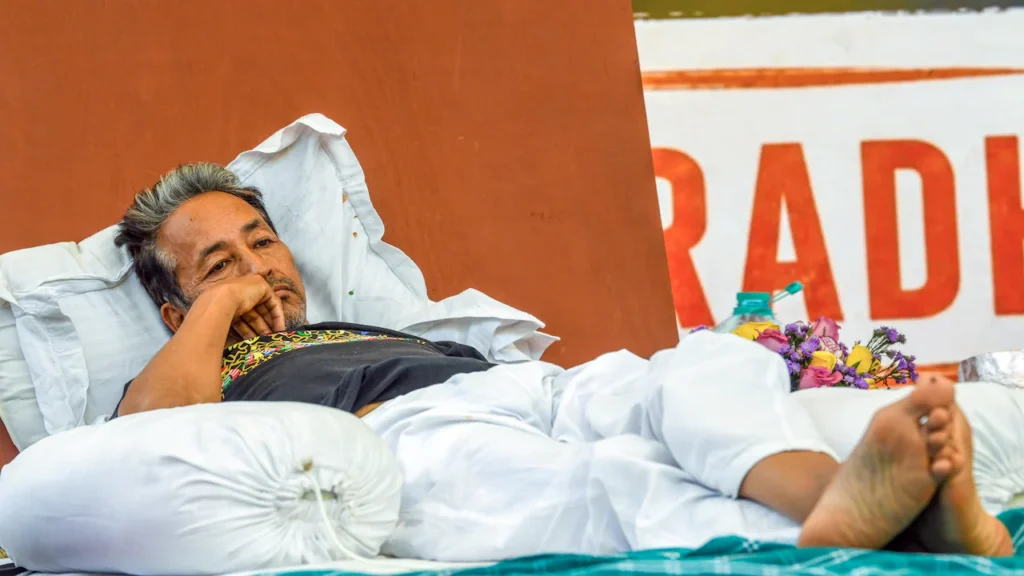
Sonam Wangchuk speaking from a hospital bed after ending his 26-day hunger strike. Image Credit: NDTV
Activist Sonam Wangchuk has explained why he ended his 26-day hunger strike amid the CJP-led protests over alleged examination irregularities and the NEET paper leak row. Speaking in a video message, he said his main concern was ensuring that students and other protesters would not face FIRs, arrests or violence after the “Sansad Chalo” march in Delhi. He added that while Dharmendra Pradhan’s resignation remained an important demand, he did not make it the decisive condition for ending the fast.
Wangchuk broke his fast shortly after midnight on Thursday after the Centre gave a written assurance that no cases would be registered against peaceful protesters, that Parliament would discuss exam reforms and paper leaks, and that compensation for families of students who died by suicide was being considered.
Why He Ended It
Wangchuk said the immediate risk of a crackdown on protesters outweighed the symbolic value of continuing the fast until the minister resigned. He explained that he was watching developments in Delhi and feared a large police action, which pushed him to accept the written assurance and appeal for calm. This story was also covered by NDTV.
He also said the government had been resisting a written assurance on no legal action, which he considered essential. According to him, ministers initially agreed to discuss compensation and parliamentary debate, but were not ready to commit in writing that no cases would be filed against peaceful participants.
Wangchuk further said the resignation demand would continue through the movement, even if it was not the condition that ended his own strike. In his words, the demand is still alive, but “my focus was that students should not suffer”.
What He Said
In the video from his hospital bed, Wangchuk said, “I don’t consider it essential for me to personally bring about this resignation.” He described the resignation issue as something the Centre could eventually be forced into anyway, saying he expected the government to “submit the resignation sooner or later” because of the pressure it was facing.
He also rejected criticism that he had struck a “deal” with the Centre. “If I had to make a deal, would I have remained hungry for 26 days?” he asked, arguing that he could have negotiated in comfort instead of fasting in Delhi’s heat.
Wangchuk added that he felt relieved only after the ministers and other representatives accepted that peaceful protesters should not face legal consequences. He said the biggest sorrow was that students, MPs and supporters who had come to back him could not be present when he ended the fast.
Background
Wangchuk had been on an indefinite hunger strike since June 28 in solidarity with the Cockroach Janta Party members, who were demanding accountability over alleged exam irregularities and the resignation of Education Minister Dharmendra Pradhan. The protest had become one of the most visible student-led campaigns in Delhi, with supporters camping at Jantar Mantar and linking the issue to broader concerns about fairness in competitive examinations.
The movement intensified after the “Sansad Chalo” march and alleged police action against protesters drew fresh attention. CJP leaders continued to press for Pradhan’s resignation even after Wangchuk ended his fast, showing that the movement is not closing down just because the hunger strike has ended.
There was also wider concern about the health of the activist, whose strike had already crossed three weeks and drawn appeals from political leaders to call it off. One report noted that his health had deteriorated significantly during the fast, and a court had ordered daily monitoring at one stage.
Timeline
June 28, 2026: Sonam Wangchuk begins an indefinite hunger strike in solidarity with the protest movement.
July 20, 2026: The CJP intensifies its campaign and renews the demand for Dharmendra Pradhan’s resignation.
July 23, 2026: Wangchuk ends his 26-day fast after receiving written assurances from the Centre.
July 24, 2026: He explains in a video why the strike ended without the resignation demand being fulfilled.
Why This Matters
This matters because it shifts the focus of the protest from a single resignation demand to a larger issue of student safety and legal protection. Wangchuk’s explanation suggests that the movement is not just about political accountability, but also about ensuring that young protesters are not punished for demonstrating.
It also matters because the issue touches a sensitive nerve in India’s education system. When exam irregularities trigger hunger strikes, student marches and demands for parliamentary debate, it shows that trust in competitive examinations is under strain. Yeh issue kaafi important hai because it affects lakhs of students and families who see exams as a route to opportunity and mobility.
For many readers, the key question is not only whether the minister resigns but also whether the system is made more transparent and fair. Wangchuk’s move may have helped prevent escalation, but the underlying anger around paper leaks and accountability is still very much alive.
India Angle
For Indian readers, this story connects directly to exam stress, youth protest and the politics of accountability. In simple Hinglish, seedhi baat yeh hai: students sirf protest nahi kar rahe, woh apni future security ke liye lad rahe hain.
The NEET row has become a national issue because it affects students from every state and family background. Any debate around paper leaks, FIRs or compensation is not abstract; it hits homes where children are preparing for highly competitive exams and parents are already worried about fairness.
Wangchuk’s decision to end the fast without demanding immediate resignation also reflects a very Indian form of protest politics, where the moral message and the tactical outcome are sometimes different. That nuance matters because many people may judge the move quickly without looking at the written assurances he says he secured for peaceful protesters.
Analysis
My reading is that Wangchuk made a pragmatic choice, not a surrender. The resignation of Dharmendra Pradhan remained part of the larger protest narrative, but Wangchuk appears to have prioritised a concrete short-term safeguard: no legal action against students and supporters who joined the march.
That makes the decision politically vulnerable but strategically understandable. Hunger strikes build moral pressure, but they also have health limits, and the longer they continue, the greater the risk that the movement loses focus or becomes about the protest leader’s condition rather than the original issue. Ending the fast after securing a written assurance may help keep the campaign alive in a less emotionally charged form.
What Next
The immediate next step is likely to be continued pressure from the CJP and allied student groups for Dharmendra Pradhan’s resignation. Wangchuk made clear that the demand is not over, even if he personally did not use it as the condition for ending his fast.
Parliamentary discussion on exam reforms and the handling of paper leaks will now become the next battleground. If the government follows through on the written assurance and avoids new cases against peaceful protesters, it may reduce tension on the ground. If not, the protests could regain momentum quickly.
There is also the possibility that this episode strengthens Wangchuk’s credibility among supporters who see him as someone who chose student safety over symbolism. On the other hand, critics will continue to ask whether ending the fast without the minister’s resignation weakens the pressure campaign.
Conclusion
Sonam Wangchuk said he ended his 26-day hunger strike because protecting students and peaceful protesters from legal action mattered more than securing Dharmendra Pradhan’s immediate resignation. The Centre’s written assurance on no FIRs, Parliament debate and possible compensation gave him enough reason to stop the fast, even as the resignation demand remains alive in the wider movement.
The episode shows how protest movements often balance moral pressure with practical safeguards. For now, Wangchuk has chosen to keep the larger campaign going while trying to protect the people at its core.
Written By A. Jack