Six-day rescue operation at THDC’s Vishnugad-Pipalkoti Hydroelectric Project ends after all missing workers are accounted for; 12 workers were rescued with injuries after the August 13 landslide.
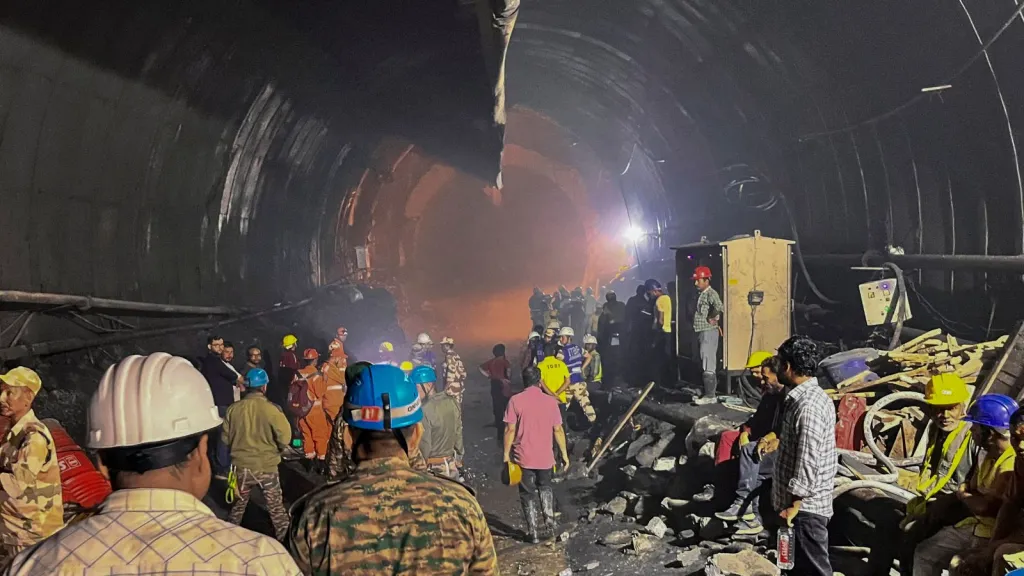
SDRF and NDRF personnel carry out search operations inside the debris-filled under-construction tunnel at the Vishnugad-Pipalkoti Hydroelectric Project in Chamoli. Image Credit: IndianExpress
The death toll in the Chamoli tunnel tragedy has risen to 10 after rescue teams recovered the bodies of two remaining missing workers from an under-construction tunnel at the Vishnugad-Pipalkoti Hydroelectric Project in Uttarakhand.
The workers were trapped on August 13, 2026, after a landslide-like event sent a huge surge of water and debris into the tunnel, where 22 people were working on concrete lining. Twelve workers were rescued with injuries, while 10 workers have now been confirmed dead.
With the recovery of the final two bodies, the six-day search and rescue operation involving nearly 200 personnel from multiple agencies has concluded, State Disaster Response Force Commandant Arpan Yaduvanshi said.
What Happened Inside the Tunnel
The accident occurred at the Tehri Hydro Development Corporation India Limited (THDC) Vishnugad-Pipalkoti Hydroelectric Project in the Mayapur-Pipalkoti area of Chamoli district.
According to officials, the workers were concreting the tunnel lining—an internal structure used to strengthen the underground passage that carries discharged water from the hydroelectric project—when a landslide near the Birhi River triggered a sudden inflow of water, muck and debris.
The force of the surge filled parts of the roughly three-kilometre-long tunnel with sludge, boulders and water. Workers inside had little time to escape. Some were rescued in the initial response, but several were either swept away by the debris flow or trapped beneath accumulated muck. This story was also covered by The IndianExpress.
Initially, 12 workers were brought out alive with injuries, while the bodies of seven workers were recovered in the early phase of the operation. One more body was found on August 17, taking the toll to nine. On Tuesday, rescue teams recovered the final two missing workers, raising the toll to 10 and bringing the operation to a close.
Two Missing Workers Identified
Officials identified the two bodies recovered on the final day of the operation as:
Lukas Topno, 31, from Khunti district in Jharkhand
Chetan Poyam, from Chhattisgarh
The bodies were shifted to District Hospital, Gopeshwar, for medical examination, identification formalities and handover procedures.
The tragedy once again highlights the dependence of large Himalayan infrastructure projects on migrant labour. Workers from Jharkhand, Chhattisgarh and other states often take up high-risk jobs in remote hydropower and tunnel sites, far from their homes and families.
For the families of Lukas Topno and Chetan Poyam, the final recovery brings closure in the most painful form. It ends the uncertainty of the rescue operation but opens a longer struggle around compensation, rehabilitation and accountability.
Six-Day Rescue Operation
The rescue mission was conducted by a multi-agency team that included the State Disaster Response Force (SDRF), National Disaster Response Force (NDRF), district administration, police, fire services, health teams and project personnel.
Nearly 200 personnel were involved in the operation, which continued despite dangerous conditions inside the tunnel. Teams had to remove waterlogged debris and sludge, search unstable areas, use lighting and pumping equipment, and move carefully to avoid a secondary collapse or another debris surge.
SDRF team in-charge Inspector Karn Singh said that despite difficult and challenging conditions, joint SDRF and NDRF teams continued the search “with utmost alertness, courage and coordination.”
Arpan Yaduvanshi, the SDRF Commandant, confirmed that the six-day search and rescue operation concluded after the recovery of the two final bodies.
The operation was especially challenging because the tunnel had filled with dense mud, debris and water. Unlike a surface rescue, tunnel disasters severely restrict access, communication, visibility and heavy-equipment movement. Every metre of clearance requires careful assessment.
Timeline
August 13, 2026: A landslide-like event near the Birhi River triggers a sudden surge of water and debris into the under-construction Vishnugad-Pipalkoti tunnel in Chamoli.
At the time of accident: Twenty-two workers are inside the roughly three-kilometre tunnel, concreting the lining of the underground water-discharge passage.
Initial rescue phase: Twelve workers are rescued with injuries; seven bodies are recovered from the debris-filled tunnel.
August 14–16: SDRF, NDRF, police, district administration and project teams continue search, dewatering and debris-removal operations.
August 17: One additional body is recovered, taking the death toll to nine; two workers remain missing at this stage.
August 18: Two more bodies are recovered and identified as Lukas Topno from Jharkhand and Chetan Poyam from Chhattisgarh.
After final recovery: Death toll reaches 10; all 22 workers are accounted for—12 injured survivors and 10 fatalities.
Operation concludes: Nearly 200 rescue personnel complete the six-day operation at the THDC project site.
Why This Matters
Yeh issue kaafi important hai because it goes beyond one accident. It raises serious questions about worker safety, hydropower construction and disaster preparedness in the fragile Himalayan region.
Ten lives lost: The confirmed death of 10 workers shows the devastating human cost of the accident.
High-risk infrastructure work: Tunnel construction in Himalayan terrain involves hazards such as landslides, water ingress, unstable rock, fault zones and sudden debris flows.
Worker protection: The victims were working inside a confined underground space, where early warnings, evacuation protocols and structural monitoring become matters of life and death.
Migrant labour concerns: Workers from states such as Jharkhand and Chhattisgarh often face the highest risk while being far from their support networks.
Project accountability: The investigation must determine whether the tragedy was solely a geological disaster or whether warning signs, site planning, monitoring or emergency safeguards failed.
The key question is not only why the landslide occurred. It is whether the project had systems strong enough to detect danger and move workers to safety before water and debris entered the tunnel.
Vishnugad-Pipalkoti Project and Himalayan Risks
The Vishnugad-Pipalkoti Hydroelectric Project is a 444-MW run-of-the-river power project being developed by THDC India Limited on the Alaknanda River in Chamoli district.dtnext+1
Run-of-the-river hydropower projects are often presented as cleaner alternatives to large storage dams because they rely on natural river flow. However, their construction can involve extensive tunnelling, blasting, slope cutting, roads, diversion works and operations in geologically sensitive mountain terrain.
Uttarakhand’s Himalayas are prone to landslides, flash floods, cloudbursts and slope instability, particularly during the monsoon. The region’s fragile rock formations, heavy rainfall and growing infrastructure footprint make tunnel work especially complex.
The Chamoli incident comes against the backdrop of previous disasters in the state, including floods, landslides and hydropower-related accidents that have repeatedly reignited debate about the pace and design of infrastructure projects in ecologically vulnerable zones.
Yeh sirf development versus environment ki debate nahi hai. The immediate question is whether development projects can be designed and managed in a way that protects workers and local communities.
India Angle
The Chamoli disaster has relevance far beyond Uttarakhand. India is expanding hydropower, highways, rail tunnels, strategic roads and urban infrastructure across Himalayan states such as Himachal Pradesh, Sikkim, Arunachal Pradesh, Jammu and Kashmir and Ladakh.
Every such project faces some variation of the same risks:
Water ingress into tunnels
Slope failure and debris flow
Unmapped geological faults
Heavy monsoon rainfall
Limited rescue access
Contractor pressure to meet deadlines
Reliance on migrant workers in remote locations
The country needs stronger, mandatory safety norms for tunnel projects. These could include real-time ground and water monitoring, independent geotechnical reviews, automatic alarm systems, worker evacuation drills, safe refuge chambers, emergency communication networks and periodic third-party audits.
India’s infrastructure ambitions are legitimate. But “fast construction” cannot become a substitute for safe construction. Agar worker safety ko design stage se priority nahi diya gaya, toh Chamoli jaisi tragedies repeat ho sakti hain.
Analysis
Rescue teams deserve credit for working in hazardous conditions and accounting for every worker. However, the fact that 10 lives were lost means the focus must now shift to prevention and responsibility.
Authorities need to establish:
Whether workers were warned about the risk of water and debris ingress
Whether geological or slope-instability indicators were recorded before the accident
Whether concrete-lining work should have been suspended due to weather or terrain conditions
Whether the project had adequate emergency exits, refuge zones and communication systems
Whether contractors and supervising agencies followed approved safety plans
Whether workers had the authority to stop work if they noticed danger
In my view as a news writer, the inquiry should be made public. Families of the dead workers deserve more than compensation announcements; they deserve a clear explanation of what failed and what will change.
What Next
The rescue operation has ended, but several important developments are expected:
Postmortem and identification formalities: The recovered bodies will undergo medical and legal procedures before being handed over to their families.
Compensation and rehabilitation: Authorities and THDC will face pressure to provide prompt compensation, jobs or long-term support to the families of the 10 deceased workers.
Medical care for survivors: The 12 injured workers will require continued treatment, and some may need rehabilitation depending on the severity of injuries.
Official inquiry: A detailed inquiry is expected to examine the landslide, tunnel design, site protocols and possible safety lapses.
Project safety review: Work at the site may remain suspended or face fresh safety conditions before resumption.
Wider audit: The Uttarakhand government may be pushed to conduct safety audits of other under-construction tunnels and hydropower sites.
Legal action: If negligence is found, action could follow against contractors, project officials or agencies responsible for monitoring.
Conclusion
The recovery of the last two missing workers has brought the Chamoli tunnel rescue operation to an end, but it has also confirmed the full scale of the tragedy: 10 workers are dead and 12 others were injured.
The victims were carrying out routine concrete-lining work inside an under-construction tunnel when a landslide-driven surge of water and debris turned the workplace into a death trap.
For the rescue teams, the operation is complete. For the families of the workers, the pain is only beginning. And for THDC, contractors and government agencies, the real test now is accountability.
Chamoli has once again shown that Himalayan projects cannot be treated as ordinary construction sites. Safety monitoring, emergency planning and respect for worker lives must come before deadlines and targets. Yeh tragedy tabhi meaningful lesson banegi jab iske baad system genuinely badlega.
Written By A. Jack