Labourers allege repeated warnings about dirty water and sinking rib were ignored before Thursday’s surge; CM orders magisterial inquiry as search for 2 missing continues.
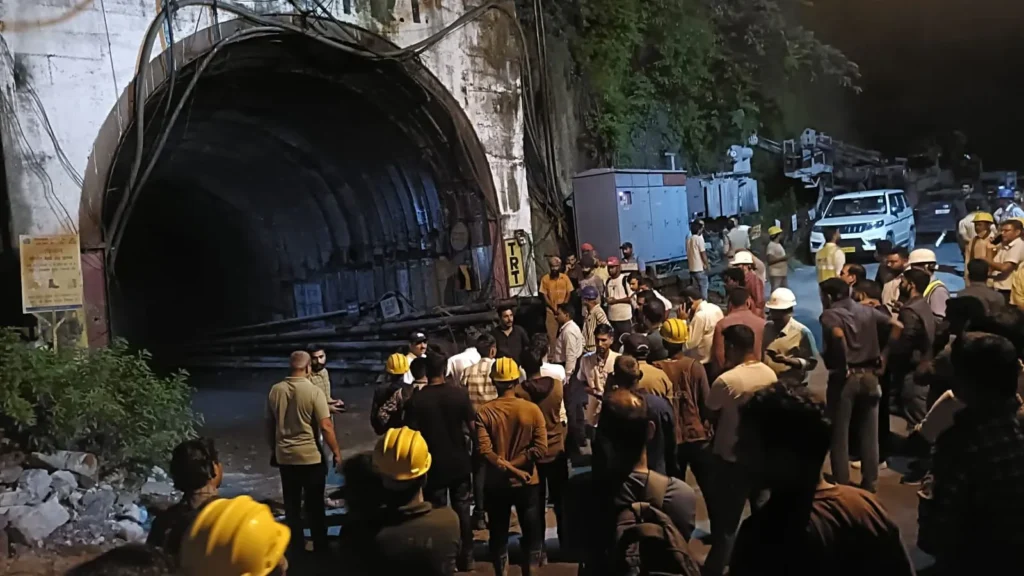
Rescue teams work at the flood-hit under-construction tunnel of the Vishnugad–Pipalkoti Hydroelectric Project in Chamoli, Uttarakhand. Image Credit: NDTV
A sudden surge of water and debris flooded an under-construction tunnel at the Vishnugad–Pipalkoti Hydroelectric Project in Chamoli district, Uttarakhand, on Thursday (August 13, 2026) evening, trapping 22 workers inside. While 12 were rescued, eight have been killed and two remain missing as search operations continue with the help of NDRF, SDRF, and district administration teams.
Now, workers on the project are raising serious allegations of negligence, claiming that dirty water had been leaking from the tunnel roof for days and that they repeatedly informed engineers and officials, but no inspection or corrective action followed before the fatal flood. Disaster Management and Rehabilitation Minister Madan Kaushik, who visited the site on Saturday, was personally approached by workers who flagged these concerns.
Warnings, Water, and Debris
According to workers, the trouble began with a change in the quality of water seeping from the tunnel roof. Ankush, a worker from Gauchar in Chamoli, told reporters that clean water had been flowing from the area where support ribs (arches) were installed, but on Wednesday, they noticed dirty water instead.
“We informed our engineers and officials about it. Our colleagues also mentioned that they had reported this. They did not come to inspect it. Instead, they told us the rib was settling,” Ankush recalled. He added that the night-shift crew had warned them to enter carefully and work with caution because the rib was sinking and that debris started falling around Thursday afternoon. This story was also covered by NDTV.
By around 7 pm on Thursday, a massive rush of water and debris entered the tunnel, trapping workers engaged in concrete lining and other activities. Survivors described a scene of chaos: a loud noise, followed by a powerful surge that swept some workers away, while others were hit by falling muck and struggled to escape through rising water.
Preliminary reports point to land subsidence and possible water seepage as triggers, though the exact cause will be established through a magisterial inquiry ordered by Chief Minister Pushkar Singh Dhami.
Statements and Allegations
Worker testimony:
Ankush’s account is stark: “It is pure negligence, sir—total negligence on the part of the company. I can’t say too much one way or the other. Everyone rushes to the spot only after an incident takes place. Before that, nobody comes to inspect or check anything… some people are just drawing their salaries for doing nothing.”
Other workers echoed similar concerns to the Disaster Management and Rehabilitation Minister during his site visit, alleging that warnings about the water leak and sinking rib were not acted upon.
Government response:
Chamoli District Magistrate Gaurav Kumar said a magisterial inquiry into the incident would be conducted following directives from the Chief Minister and the disaster rehabilitation minister. “Orders for the inquiry would be issued soon, after which the causes of the accident and any potential negligence would be investigated,” he added.
CM Dhami, in a statement, confirmed the scale of the tragedy: “At the THDC tunnel under construction in Chamoli, a sudden surge of debris and water trapped 22 workers who were on duty at the time. Search operations are on. All agencies, including the NDRF, SDRF, and the Uttarakhand government’s district administration, are keeping a constant watch on the situation.” He has also announced ex-gratia compensation of Rs 4 lakh each for the next of kin of the deceased workers.
Project entities:
The tunnel is being executed by Tehri Hydro Development Corporation (THDC) as part of the Vishnugad–Pipalkoti Hydroelectric Project, with actual construction work carried out by Hindustan Construction Company (HCC). Attempts to contact company officials for comment were unsuccessful at the time of reporting.
Background
The Vishnugad–Pipalkoti Hydroelectric Project (VPHEP) is a 444-MW run-of-the-river scheme on the Alaknanda River in Chamoli district, implemented by THDC India Limited. The under-construction tailrace tunnel (TRT), where the accident occurred, is a critical component of the project, designed to channel water back to the river after power generation.
Uttarakhand has a long and painful history of tunnel and hydropower-related accidents, often linked to the state’s fragile geology, heavy rainfall, and complex hydrological systems. The February 2021 Rishiganga–Dhauli Ganga disaster, which killed over 80 people, remains a grim reminder of the risks associated with hydropower infrastructure in the region. downtoearth.
In this context, every new tunnel project carries heightened scrutiny over geological surveys, drainage management, and emergency protocols. The Chamoli incident has reignited debates about whether safety is being compromised in the push to expedite hydropower capacity. downtoearth.
Timeline
Wednesday (August 12, 2026): Workers notice dirty water leaking from the tunnel roof near a support rib; they allege they inform engineers and officials, but no inspection follows.
Thursday afternoon (August 13): Debris starts falling inside the tunnel; night-shift crew warns others to work with caution as the rib appears to be sinking.
Thursday, ~7 pm: A sudden surge of water and debris floods the tunnel, trapping 22 workers; loud noise is reported, followed by rapid inundation.
Thursday night–Friday: Rescue operations launched; 12 workers rescued, seven bodies recovered (later eight), and several injured admitted to District Hospital, Gopeshwar.
Friday–Saturday: CM Dhami orders magisterial inquiry; announces Rs 4 lakh ex-gratia for families of the dead; Disaster Minister visits site, workers allege negligence.
Ongoing: Search for two missing workers continues with NDRF, SDRF, and local teams.
Why This Matters
Yeh issue kaafi important hai kyunki yeh seedha asar pad raha hai worker safety, project accountability, aur Uttarakhand ke hydropower sector ki credibility par.
Worker safety: If workers’ allegations are proven true, this tragedy could have been averted with timely inspection and remedial action on the water leak and rib settlement.
Corporate accountability: The incident raises tough questions about on-ground safety culture, reporting mechanisms, and whether warnings from labourers are taken seriously by engineers and management.
Public trust in hydropower: Repeated accidents in Uttarakhand’s hydropower projects erode public confidence and fuel opposition to new schemes, especially in ecologically sensitive zones.
Regulatory oversight: The magisterial inquiry will test whether the system can identify negligence, fix responsibility, and enforce stricter safety norms going forward.
India Angle
For Indian audiences, especially in the Himalayan states, this story resonates deeply:
Himalayan fragility: Uttarakhand, Himachal Pradesh, Arunachal Pradesh, and Sikkim all face similar geological and hydrological risks. A lapse in one project echoes across the region.
Labour rights: Migrant and local workers on infrastructure projects often lack strong unions or bargaining power. Their warnings can be easily ignored unless backed by robust safety committees and whistleblower protections.
Energy vs environment: India’s push for clean energy must balance hydropower expansion with ecological sensitivity and worker safety. Chamoli is a test case for how this balance is managed on the ground.
Agar is haadse se sachchi seekh mili, toh future projects mein early warning systems, mandatory geotechnical monitoring, aur worker-led safety audits par zyada focus hoga.
Analysis
But beyond search, the narrative is structurally significant:
Preventable disaster narrative: Workers’ claims of prior warnings frame this as a potentially avoidable tragedy, shifting focus from “natural calamity” to “systemic failure.
Accountability gap: The alleged inaction on leak reports highlights a common pattern in infrastructure projects: top-down decision-making with weak feedback loops from frontline workers.
Policy pressure point: The magisterial inquiry and political attention create an opening for stronger safety regulations, mandatory risk assessments, and real-time monitoring in hill-state hydropower projects.
For follow-ups, newsrooms can track inquiry findings, action against responsible officials or contractors, and whether new safety protocols are mandated for THDC and other hydropower developers.
What Next
Magisterial inquiry report: Expect a detailed probe into geological conditions, drainage design, warning responses, and compliance with safety norms; recommendations may include stricter oversight and penalties.
Action against negligence: If negligence is established, disciplinary action could follow against site engineers, safety officers, or contractor representatives, along with possible legal cases.
Safety audits across projects: The state government may order comprehensive safety audits of all under-construction tunnels and hydropower sites, especially in Chamoli and adjoining districts.
Compensation and rehabilitation: Beyond the announced ex-gratia, there may be demands for higher compensation, job assurances for families, and better medical support for the injured.
Conclusion
The Chamoli tunnel tragedy is more than a statistic—eight dead, two missing, and dozens of grieving families. It is a story of warnings ignored, of dirty water dismissed as “rib settling”, and of workers who say they spoke up but were not heard.
As the magisterial inquiry begins, the real test will be whether the system treats this as an isolated accident or as a symptom of deeper safety and accountability gaps in Uttarakhand’s hydropower push.
Ab dekhna yeh hai ki kya is baar sach mein jawabdehi tay hoti hai, aur aane wale projects mein worker warnings ko seriously liya jaata hai—warna yeh sirf ek aur headline ban kar reh jaayega.
Written By A. Jack