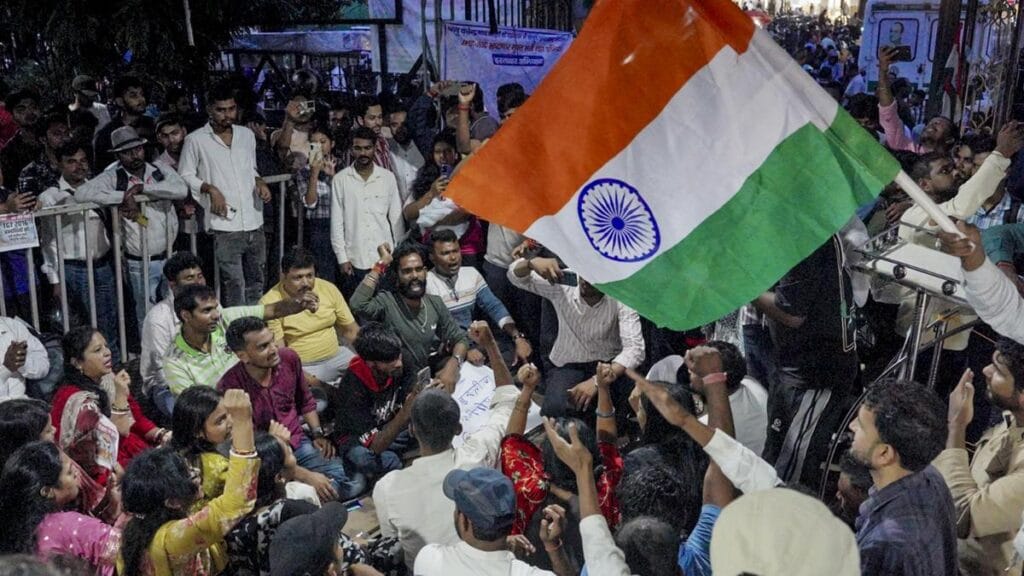
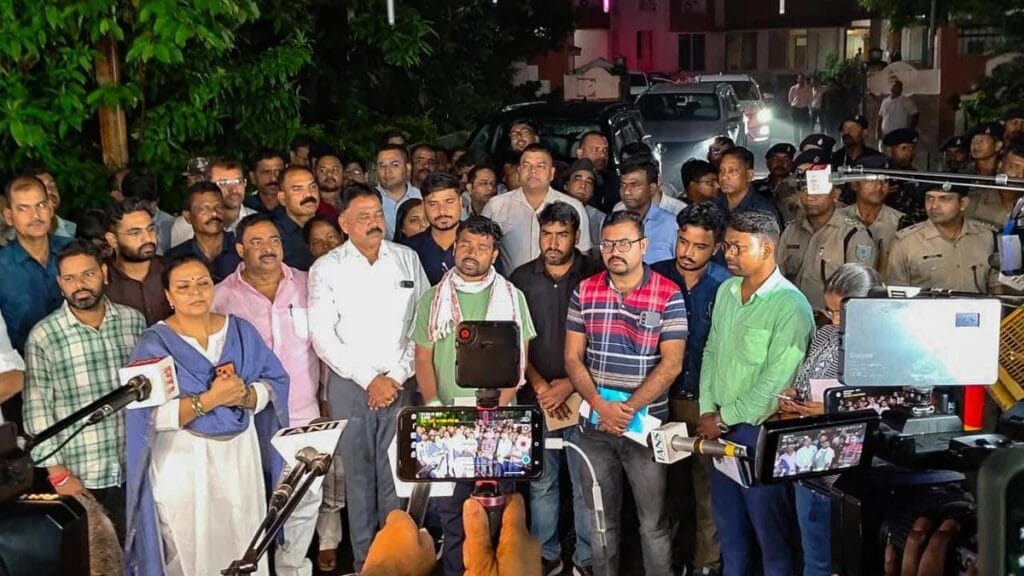
Students enter Day 23 of stir, accusing Congress of failing to act on the CBI probe promise; the state invites protesters for a Monday meeting as a gherao of the CM’s residence looms.
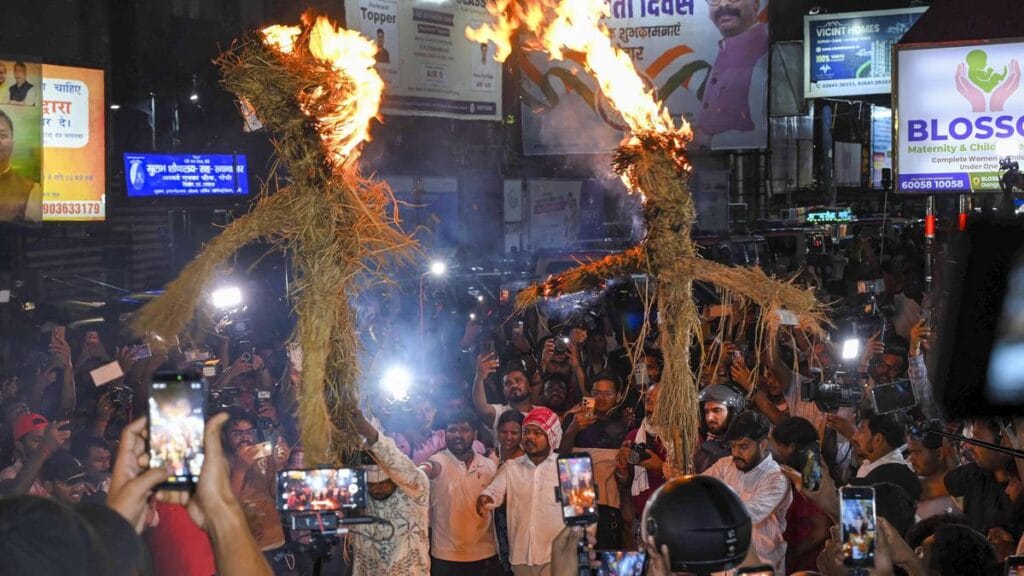
Protesters burn effigies of Jharkhand Chief Minister Hemant Soren and Congress leader Rahul Gandhi during the JPSC–JSSC exam agitation in Ranchi. Image Credit: TheHindu
On the 23rd day of their protest over alleged irregularities in Jharkhand’s recruitment examinations, students burnt effigies of Chief Minister Hemant Soren and Congress leader Rahul Gandhi at Jaipal Singh Munda Stadium in Ranchi and at district headquarters across the state, accusing the JMM–Congress alliance of failing to act on their core demand for a CBI probe.
Later that day, the state government reached out to protest leaders for a fourth round of discussions, inviting them to a meeting on Monday (August 17, 2026) between 2 pm and 3 pm at the State Guest House in Ranchi, as confirmed by Ranchi Sadar Sub-Divisional Officer (SDO) Kumar Rajat. The move comes as protesters have issued an August 18 ultimatum to the government and announced plans to gherao (surround) the CM’s residence on August 20 if their demands are not met.
Why and How the Effigy Burnings and Fresh Talks Happened
The escalation to effigy burnings of both CM Soren and Rahul Gandhi reflects growing frustration among job aspirants who say the ruling alliance has not delivered on assurances made at the start of the agitation. Hundreds of students have been camping at the Ranchi stadium since July 25, demanding a CBI inquiry or an independent judicial panel into alleged irregularities in the Jharkhand Public Service Commission (JPSC) Combined Civil Services Examination and the Jharkhand Staff Selection Commission–Combined Graduate Level (JSSC-CGL) exam, among others. This story was also covered by The Hindu.
According to Ravindra Paswan, leader of the JPSC–JSSC Reform Manch, Congress leaders—including Rahul Gandhi—had reportedly assured protesters that if the Soren government did not take positive steps or provide a satisfactory response by August 15 (Independence Day), the party would withdraw support from the JMM-led regime. With August 15 passing without what students call “concrete steps,” protesters say they feel let down by both the state government and its key ally.
In response to the heightened anger, the state administration has opted for another round of dialogue rather than confrontation. Kumar Rajat, the Ranchi Sadar SDO, confirmed via WhatsApp to The Hindu that students have been invited for talks on Monday afternoon, marking the fourth meeting between the government and the protest leadership.
Statements and Claims
Protest leaders’ stance:
Ravindra Paswan said, “We have already announced that if the government does not listen to our demands by August 18, we will gherao the CM’s residence on August 20. We have no other option left.” He reiterated that when the agitation began, Rahul Gandhi had assured them that if CM Soren failed to act by August 15, Congress would withdraw support from the JMM-led government—a promise protesters say remains unfulfilled.
Government’s move:
The Jharkhand government has not issued a detailed public statement on the effigy burnings but has signaled willingness to talk. The invitation for a fourth round of discussions, to be held at the State Guest House with a delegation of ministers, indicates an attempt to de-escalate tensions before the proposed August 20 gherao.
Congress’s position:
While some Congress leaders have expressed solidarity with the students and called for accountability, the party’s state leadership has so far rejected the demand for a CBI probe, pointing to the ongoing CID investigation and recent arrests in exam-related cases. Jharkhand Congress in-charge K. Raju told reporters that a CBI inquiry is not necessary as the CID is already investigating and has made arrests, a stance that puts the party at odds with the protesters’ core demand.
The JPSC–JSSC Exam Protest and Political Stakes
The JPSC–JSSC Reform Manch has been protesting since July 25, 2026, at the Jaipal Singh Munda Stadium in Ranchi, demanding:
Cancellation of the JSSC-CGL examination and certain JPSC exams (including the 14th JPSC prelims and backlog tests)
A CBI probe or an inquiry by a panel of retired judges from outside Jharkhand into alleged irregularities
Systemic reforms in JPSC and JSSC functioning, including transparency in question paper setting, evaluation, and result declaration
The agitation has grown into a major political flashpoint for the JMM–Congress–RJD coalition government. Protesters have repeatedly urged Congress to withdraw support if their demands are not met, citing what they claim was an assurance from Rahul Gandhi. The burning of effigies of Soren, Rahul Gandhi, and RJD leader Tejashwi Yadav signals that anger is now directed at the entire ruling alliance, not just the JMM.
The government, meanwhile, has held three rounds of talks so far, offering some concessions but stopping short of agreeing to a CBI probe or wholesale cancellation of exams. With students announcing a large-scale gherao of the CM’s residence on August 20—reports suggest up to one lakh participants could join—the stakes for the Monday meeting are exceptionally high.
Timeline
July 25, 2026: Students begin protest at Jaipal Singh Munda Stadium, Ranchi, demanding CBI probe into JPSC–JSSC exam irregularities.
Late July–early August: Multiple rounds of talks between protest leaders and state government; some demands addressed, but core issue of CBI probe remains unresolved.
August 15, 2026 (Independence Day): Protesters say Congress had promised to withdraw support from the JMM-led government if no satisfactory response was by this date; claim the promise was not fulfilled.
August 16, 2026 (Day 23): Effigies of CM Hemant Soren, Rahul Gandhi, and Tejashwi Yadav burned across 24 districts; protesters announce August 18 ultimatum and August 20 gherao of CM’s residence.
August 16 (later): State government invites protesters for the fourth round of talks on Monday (August 17), 2–3 pm, at State Guest House, Ranchi.
August 17, 2026 (scheduled): Fourth round of talks between student delegation and ministers; outcome expected to shape whether gherao proceeds on August 20.
August 20, 2026 (proposed): Students plan to gherao CM Soren’s residence if demands are not accepted by August 18; around one lakh participants are expected, according to protest estimates.
Also Read: Jharkhand Exam Stir: Police Lodge FIR Against 500+ Unidentified Protesters After Assembly March
Why This Matters
Yeh issue kaafi important hai kyunki yeh seedha asar pad raha hai youth employment par, public trust in recruitment systems par, aur Jharkhand ki ruling coalition ki stability par.
Career stakes: Thousands of aspirants have invested years preparing for JPSC and JSSC exams. Alleged irregularities shake their faith in the system and delay their entry into government jobs.
Institutional credibility: If exam processes are not seen as fair, it undermines the legitimacy of future recruitments and fuels cynicism among educated youth.
Political pressure: The protest has put the JMM–Congress–RJD alliance under strain, with students demanding Congress withdraw support if their core demand for a CBI probe is not met.
Law-and-order risk: A large gherao of the CM’s residence could lead to confrontations with police, especially if permissions and crowd management are not handled carefully.
India Angle
Jharkhand’s exam stir is not an isolated case. It fits into a larger, pan-India pattern where recruitment exam controversies—paper leaks, answer key disputes, and alleged manipulation—have triggered massive protests in multiple states.
For India, yeh ek warning signal hai ki agar recruitment system transparent nahi hoga, toh youth ka trust tootega aur unrest badhega. States are increasingly under pressure to:
Adopt third-party monitoring for high-stakes exams
Ensure real-time grievance redressal
Bring in external agencies like CBI or judicial panels when serious allegations arise
Jharkhand’s protest is now being watched as a test case: can the state balance student demands, investigative integrity, and political stability without long-term damage to its recruitment ecosystem?
Analysis
But beyond search, the narrative is strategically layered:
Alliance stress test: The demand for Congress to withdraw support puts the coalition’s internal dynamics under a microscope. How the party balances its national youth image with state-level coalition compulsions will be closely watched.
Credibility vs. control: The government’s willingness to hold a fourth talk suggests it wants to avoid a major confrontation before the gherao. But without movement on the CBI demand, talks may only delay, not resolve, the crisis.
Escalation logic: Effigy burnings of both the CM and the opposition leader show protesters are signaling that patience is ending. The August 20 gherao is designed to be a high-visibility pressure tactic, not just a local rally.
For follow-ups, newsrooms can track the outcome of Monday’s talks, any shift in Congress’s stance on CBI, and preparations for the August 20 gherao, including police response and permissions.
What Next
Monday’s talks (August 17): If the government offers a credible roadmap—such as a time-bound external inquiry or clear action on exam cancellations—protesters may pause the gherao plan. If not, escalation is likely.
Congress’s next move: Pressure will mount on Congress to clarify whether it will withdraw support if the CBI demand is not met, a decision that could reshape Jharkhand’s political landscape.
August 20 gherao: If talks fail, expect a large crowd at the CM’s residence, heavy police deployment, and potential clashes if the protest is not fully sanctioned or if crowd control breaks down.
Long-term reforms: Regardless of the immediate outcome, the state will likely face sustained pressure to overhaul JPSC–JSSC processes, introduce stronger oversight, and restore youth confidence in recruitment exams.
Conclusion
The burning of effigies of Hemant Soren and Rahul Gandhi marks a sharp escalation in Jharkhand’s exam protest, reflecting deepening anger over what students call unfulfilled promises on a CBI probe. The government’s decision to call a fourth round of talks on Monday shows it wants to avoid a major confrontation before the proposed August 20 gherao of the CM’s residence.
For the JPSC–JSSC aspirants, this is about more than one exam—it is about trust in the system that decides their careers. For the ruling alliance, it is a test of political management and credibility.
Ab dekhna yeh hai ki kya Monday ki baatcheet mein koi solid roadmap nikalta hai, ya phir August 20 ko Ranchi mein ek bada political showdown dekhne ko milega.
Written By A. Jack